Comfortable In Our Own Skin

It’s been a sport for a while, picking on the Jaguars and Jacksonville. From the time the league granted the franchise in November of ’93 in Chicago, it’s been an ongoing theme among those covering the game. “Jacksonville?” was the response when St. Louis, Baltimore and Memphis lost out for the thirtieth NFL franchise. “It’s a backwater, an outpost,” one national writer said to me in the Airport Hyatt Hotel lobby the day after the franchise was awarded. “Really?” I said in response. “You’ve been there?”

“Of course not,” he said. “I’ve been through it on the way to Orlando. It stinks, and there are a bunch of tolls.”

“You know that was twenty years ago (now fifty), right?”

“Huh,” was his response as he walked off.

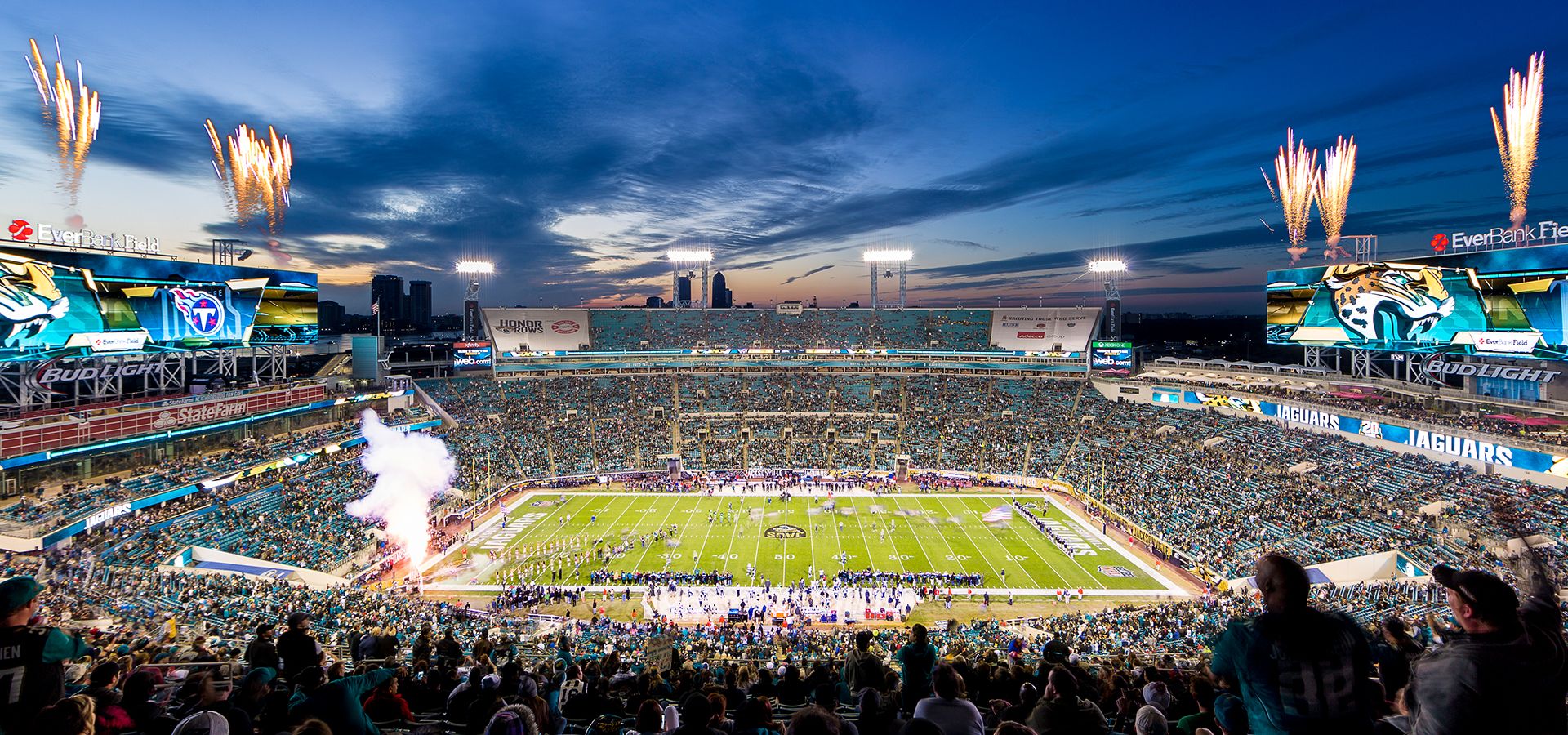
Just over a decade later, Jacksonville hosted the Super Bowl, and the response was the same.

“Worst Super Bowl ever,” Howie Long tells crowds at his speaking engagements. “They even ran out of hot dogs,” he explains. Never to research that it’s the NFL, and not the host city who’s responsible for the number of hot dogs in the stadium. Maybe New England the Philadelphia fans were just hungry that night.

Admittedly, the cruise ship thing wasn’t thought out to the end, with folks staying on the ships after the game having to be on the dock before 8AM so the ships could leave for their various ports of call that week. Lots of complaints about the weather, but all from the media. When they arrive, usually on Monday, they’ve got nothing to talk about, but they’ve got to keep the meter moving, so bashing Jacksonville, and the iffy weather was a common theme. But fans who came to the game, ninety percent of whom didn’t arrive until after noon on Thursday, saw nothing but sunny skies and temperatures in the high sixties during the day. But don’t let that get in the way of your narrative. Jacksonville did need another big hotel besides the Hyatt to properly host the game, and more cabs, but the main complaint was “not enough strip clubs,” and “no late night places to drink.” Even free rides everywhere, a media party at the 17th hole at TPC with free liquor and food and Hootie and the Blowfish entertaining couldn’t mollify the coddled media. Do you think the NFL owners are worried how the media is entertained? They all stayed at the Ritz at Amelia or the Ponte Vedra Inn and Club. They were just fine.

So, the narrative continued.

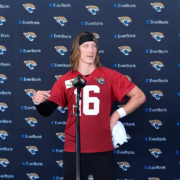
This week when Broncos Head Coach Sean Payton referred to the Jaguars as a team playing well, “even though from a small market,” it’s all the Jaguars needed to get fired up. Payton said he didn’t mean anything by it, but Jaguars Head Coach Liam Coen ran with it, and even took a swipe at the comment in his winning, post-game press conference saying, “It’s good that a team from a small market can come into here at Mile High and get the job done.”

What did Payton’s comment about “small market” even mean? Usually when people talk about market size, it’s a reference to TV markets. Everybody knows New is number one, followed by LA and Chicago. Dallas and Philadelphia make up the top five.
Jacksonville has grown exponentially in market size in the three decades the Jaguars have been in existence. Right now, Las Vegas and Jacksonville alternate between forty and forty-one, depending on how fast people are moving to either city. Payton should know something about “small markets” since he coached, when not suspended, in New Orleans, currently fiftieth. Buffalo is fifty-fourth, Green Bay is 68th. And “small market” means nothing in the NFL with revenue sharing, a salary cap and all owners as billionaires. (BTW, market size is determined by the number of people your TV signal reaches which is why amalgamated markets like Raleigh-Durham, Greenville-Spartanburg-Ashville-Anderson and Sacramento-Stockton-Modesto are all considered top twenty-five markets. Hartford-New Haven are considered bigger than Jacksonville with Harrisburg-Lancaster-Lebanon-York right behind. Half of the Jacksonville market TV signal goes out to sea, so the size starts behind to begin with. (It’s all about sales)

More importantly, Coen has latched onto something that is motivating his team and connecting him with fans at the same time. His team feels “disrespected” and is playing with a bit of a chip on their shoulder each week. But he’s also realized that people who live here have dealt with that their whole lives. I wouldn’t call it a “Second City” mentality, but nobody who is not from here understands why we live here. And it irritates them. We’re perfectly happy living here, and pretty comfortable in our own skin. We don’t want to be Orlando or Tampa or Miami and certainly not Atlanta, and that irritates them to no end. I’ve stopped defending it or trying to explain it to people, instead, just smiling and inviting them for a visit.

I’ve been to every NFL city and when you go from the airport to the hotel to the stadium and back to the airport, none of them are a picnic. Some worse than others. And having covered nearly forty Super Bowls, I can name a dozen I’d call “worse” than ours.

But why?

I was getting paid to be there, working and when you’re the center of the American sports universe for a week, just about everything about it is a pain in the butt. But entertaining fans is what the game is about and putting on a TV show. Not entertaining the media.

So, when the bashing continues, ignore it. Know that you’re comfortable in your own skin, happy to be here and celebrating a winning football team.
Enjoy it, we know how fleeting it can be!
Dispatches From The Ryder Cup

Photo by Bryan Berlin

“Hey, I ‘won’ a chance to buy Ryder Cup tickets,” my friend Dirk said on the other end of the phone one spring afternoon earlier this year.

“Great,” I responded.  “You should get them.  Even if you don’t’ go, they’re worth something.”

Ten minutes after our chat, my phone rang again with Dirk explaining, “The code worked.  Send me some money.  We’re going to the Ryder Cup.”

And with that, I circled the weekend on the calendar.

Everybody used to dread flying into LaGuardia, me included.  But after the renovation, I’ll admit, it’s fabulous.  Clean, bright, easy to navigate, it’s gone from a third-world airport to one that rivals most in the US.  That still didn’t prep me for the cacophony of sights and sounds when I walked out front.  At one time or another, all three of my children have lived in New York, with my youngest daughter starting her college career at NYU.  So, I’m not unfamiliar with The City, but I guess I’ve lived in “the bubble” for a while and I literally did a double-take when stepping outside to encounter a swarm of people and cars in what I was hoping was controlled chaos.

An Uber ride to Dirk’s place on the Upper East Side was uneventful and the weekend was in motion.

You could tell the PGA of America spent a lot of time planning how to get crowds to and from Bethpage Black out on Long Island.  From the city, two Subway trains connected us to the Long Island Railroad where a change of trains in Jamaica dropped us in Farmingdale.  Luckily, we knew where we were going, because the stop prior to Farmingdale was Bethpage.  A lot of folks got up to get off there but were deterred by the other passengers.   It seemed every bus in the state of New York was lined up in the parking lot, with Disney-like winding queues delivering fans to one bus after another for the 10-minute ride to the golf course.  From there, about a half mile walk put you at the golf course.

With everybody else.

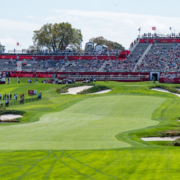
Having attended thousands of sporting events all over the world, I’ve never seen anything like the Ryder Cup.  The organizers, mostly the PGA of America, built a whole city at Bethpage Black.  Spectator stands were everywhere creating an amphitheater around nearly every hole.  And with only four matches on the course on Friday and Saturday morning and afternoon, 50,000+ fans all seemed to want the same viewing spots.  Consequently, it was at least twenty deep around every green, the stands were full, and the tees and fairways lined with fans. We saw some golf, but not much. Even with twelve singles matches on the course on Sunday, there were people everywhere.  We walked back to the twelfth green and it was still packed.  We settled for a spot near the 5th green and the 13th fairway with a view of the 13th green.

It’s a real mix of people at the Ryder Cup, feeling more like a mix of a WWE event and a Premier League soccer match. Chants of “USA, USA” were drowning out some of the songs and the “Ole, Ole, Ole, Ole” of the European fans.

And it was fun.

Except when it wasn’t.

I like talking to all kinds of people and my career afforded me that opportunity on a regular basis.  So, to be standing next to a family dressed in blue wigs and yellow tutu’s, chatting them up was fun.  They were in from the UK and had really enjoyed their stay.  That’s when some doofus on the rope started yelling insults at Robert McIntyre.  No regard for the families, women and children there.  No regard for the other fans who were on the positive side of chanting.  No regard for his own reputation. Which was shot.

Any kind of good-nature banter, even clever heckling is acceptable at the Ryder Cup where it wouldn’t be in any other golf setting.  But outright rude, boorish behavior isn’t welcome anywhere.

My friend Rob says I’m the best baseball heckler he’s ever heard.  Because of my career, I knew a lot of unreported details about players and would call some of those out during the game.  Perhaps my greatest fan moment was getting Dave Winfield to step out of the box and laugh at Memorial Stadium when I made an “insider” comment from behind the screen. (He went on to hit two homers that night against the Orioles.)

But there’s a line, and regrettably, too many fans at Bethpage crossed over it often. Personal insults, family comments and obscenities are off-limits.  It’s sports.  It’s supposed to be fun.  Get creative and say something clever and smart.  As the saying goes, “Better to be thought a fool than to open your mouth and remove all doubt.”

USA Captain Keegan Bradley didn’t do himself any favors with his comments to open the competition, sprinkling in an obscenity to fire up the crowd.  The PGA of America realized their mistake in hiring a comedienne as the “hype woman” at the first tee when she participated in a low brow insult chant aimed at Rory McElroy. She resigned that night, and has subsequently apologized but really?  It’s not that hard to keep things funny, no matter the reputation the fans of New York bring to a competition.

If I wore an Oriole hat to a Yankees game in the Bronx, I might be asking for it.  A Jaguars jersey at a Jets game is goading on the home fans.  But as McElroy said, “Golf should expect a higher standard.”

It was strange that Rory was the player who drew the ire of some fans compelled to debase themselves.  Yes, he’s the dominant player and has had plenty to say about winning a Ryder Cup on the road, but earlier in the week he called the United States “The greatest country on Earth.”  He went on to laud the land of opportunity.  He has made his home here for years. (Although he’s now building a big house at Wentworth, just outside of London.)

I’m hoping to go to the Ryder Cup in Ireland at Adare Manor in 2027.  I’ll wear my Stars and Stripes shirts and my USA hat, and I’ll expect some pretty good ribbing from the Euros.  But hopefully they get it.  We’re there to have fun, to support our teams and hopefully, not cause any trouble.

And maybe our guys will make a few putts.

A Shift in Jaguars Culture

If there were a combine report on the 2024 Jaguars, you’d think they were a lock to win the Super Bowl. They could run, they were fast, they could jump, and they could bench press forever. But could they play football? Not very well. That’s where talent evaluators differ in any sport. Are you focused on how fast a guy is in the 40? (almost a useless metric) Or, as Bobby Bowden used to say, is he faster than whatever’s chasing him?

Prior to the season, Jaguars owner Shad Khan said the 2024 roster was “the best team in Jaguars history.” He should have asked somebody about that before making that statement, because the 1999 team is easily the best team in Jaguars history. Last year’s squad could have been the best collection of talent in the last thirty years, but they weren’t the best team, not even close.

You could walk into any locker room or clubhouse in any sport and almost instantly tell if that collection of players was a team or not. Former Jaguars Head Coach Tom Coughlin used to say they had to have “an intense affection for one another.” While that sounded strange, it’s absolutely true. Players have to play for each other, care for each other, and want to win for each other. In order to achieve that, leadership has to emerge among the players. It can’t come from the front office or from the coaching staff, it has to come from in that locker room.

“It’s just creating a culture,” Dwayne Smoot said after Sunday’s win over Carolina. “This camp was one of the most physical camps I’ve had. So that’s just a culture we’re trying to build here is to be as physical as we can.”

And the Jaguars had none of that in 20204.

You might think it always comes from the quarterback, but that’s not the case. Trevor Lawrence had to deal with injuries last year, but he’s not the rah-rah guy or the “enforcer” in any situation. Neither was Mark Brunell on the most successful teams in the late ‘90’s. Tony Boselli was. So was John Jurkovic, and Clyde Simmons and in a certain way, guys like Tom McManus carried the load by example. Maybe not in games, but in the locker room and the weight room and on the sidelines sometime in the third quarter when the tone of the game is decided. Calais Campbell was that guy for the Jaguars during their run in 2017. It wasn’t Blake Bortles. Campbell kept everybody straight, even Yannick Ngakoue.

And that’s what the Jaguars have been lacking since they traded Calais while he was the Walter Peyton Man of the Year. And never more glaring than last year. Even Lawrence called his team “fragile.” When the hole opened up, there wasn’t anybody to stand in it and say, “Me or you, and it’s going to hurt.” (Lonnie Marts asked me to amend that statement to say, “But I’m going to make sure it hurts more for you than me!”) And this isn’t a criticism of Lawrence, or Foye Oluokun or Dewey Wingard. They aren’t that type of person. Maybe Dewey a bit but he didn’t have a big enough role in the past.

That’s why this 2025 team looks and acts differently. Previous GM’s and personnel directors studied height and weight, speed and size. They valued draft capital. Current GM James Gladstone and Boselli, in his role as VP value players. Why else would they sign an eight-year veteran free-agent like linebacker Dennis Gardeck? There’s nothing in his career that screams “we need him” except that he’s a football player. A culture guy, a locker room guy, a weight room guy. He knows how to get through an NFL season. He’s been on winning and losing teams. That’s why they acquired Khalen Saunders from New Orleans and Tim Patrick from Detroit. They’re football players.

Call it toughness, call it whatever you want, but new Head Coach Liam Coen has been talking about a shift in the culture since his first day in January.

“When you can start there and say, guys, look, if this is going to be part of our DNA, for it to show up in Week 1 matters,” he said on Monday. “It does matter because a lot of the things that you’re preaching did show up.”

An Investment in Rory

Watching the NCAA National Championship game in 2002, my alma mater, The University of Maryland, was locked in a tight battle in the second half.  I was at my friend Peter’s house when I walked outside to grab a drink off the porch.  Watching through the window, the Terps took a two-point lead as I opened the bottle.  As any sports fan knows, I was now stuck, and watched the rest of the game through the window as Maryland won the title.  Silly, I know, but it’s the kind of thing sports fans do.  If I had walked inside and the Terps lost, I’d have never forgiven myself.

At this year’s Masters, it seemed everybody had that same feeling about Rory McElroy.  Why was everybody so invested in Rory?  He hadn’t won a Major in over a decade, he had several chances that didn’t come to pass, mostly of his own doing.  He had several personal picadillo’s in the last ten years that made you scrunch up your face and say, “What?”

His loyalty to the PGA Tour in the LIV Split has been lauded, but he’s also been divisive, which seemed unnecessary.  He left the grounds after getting beat at the US Open last year (and beating himself), he announced, for a short time, he was getting divorced, grabbed a phone from a fan he didn’t like taking his picture and has been petulant on more than one occasion.

And still, we were all invested in Rory like never before.

Was it history?  Certainly, his quest for golf’s career Grand Slam is a massive story.  But were we that invested in Greg Norman in the ‘90’s when he was the most dominant player but couldn’t finish?

“Greg’s a jerk,” Don, a golfer and a fan told me in the 19th hole last week.  “Nobody cared if Norman won or lost.  In fact, a lot of people were happy he was getting beat.”

Clearly that’s not the case with Rory.  He’s a likeable guy who we’ve seen grow up in front of our eyes.  He’s been available to us, and he’s revealed himself to us over the years unlike many modern-day sports stars.  We know when he’s happy and we know when he’s not, because he tells us. An unusual trait among most privacy-seeking athletic superstars.  He’s human and reveals that almost weekly.

There’s also the matter of his particular greatness on the golf course.  His swing is envied by all.  Prodigiously long and constantly trying to get better, McElroy seems to always be there.  When he’s on, there’s nobody better.  And when he’s off, he’s usually still in it and providing theater with every shot.

“Almost Arnold Palmer-like,” my friend Rob theorized during our post-Masters debrief.  “You’d be rooting for Arnold, and he’d triple sixteen or three-putt the last hole and you’d be exasperated.  Rory’s the same way.”

Did the golfing public live and die with Arnold every time he played in the PGA trying to complete the Grand Slam?  Actually yes. Did golfers tune in with anticipation when Tom Watson was trying to complete the Grand Slam as he played the PGA?  Not really.  Watson was detached and somewhat aloof, never as available as McElroy.  And nobody has ever been as gracious in defeat in any sport as Palmer and Jack Nicklaus.  Jack’s arm around Watson at Turnberry at “The Duel in the Sun” is legendary.  Any comparisons to them would fall short.

But golf coverage, and information in general was much harder to come by.  In this information age, everything is almost cartoon like, blown way up and often out of proportion, good or bad, then shoved into the past.  So, in the moment, Rory’s victories and defeats seem outsized, for just a moment.  And in more detail, because we see everything in some media, the collective investment with Rory among sports fans rose and fell with every shot.

“I wish he had just said he hit it off the toe and it was an awful shot,” my brother Gust said with a laugh talking about McElroy’s in explicable water-bound third shot at thirteen in the final round. “That whole thing about it being on a slope and he usually pulls it left, nobody bought that.  It was just a terrible shot, and he should have just said that.”

Between the heightened coverage, the historical quest and McElroy’s standing among this century’s sports stars, the focus was on him as he crept up the leaderboard Friday and Saturday.  But perhaps an overlooked part of the intense interest was that fact that it was at The Masters.

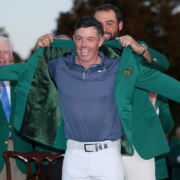
For all the talk of the Open Championship crowning the “Champion Golfer of the Year,” The Masters is the most important tournament on the calendar.  The intense scrutiny of the tournament and Augusta National Golf Club and the golf course is unprecedented worldwide.  The Open Championship is beloved as a sporting competition by golfers everywhere, but The Masters is revered by golfers and casual sports fans alike.  The “Green Jacket” as a trophy is recognized by other sports champions as the ultimate symbol of achievement and excellence.

Now that Rory has achieved the ultimate goal in his sport, does he sit back in satisfaction?  Does his game fall off a bit?  Or is he freed up to not play even better and continue winning?  I think the latter is true, but one thing that won’t change is sports fans investment in Rory.  He’ll still be the favorite, even among the “Yeah, but” crowd.  Too relatable, too real and too much like us for that to change.

I liked what golf writer Kyle Porter said of Rory’s emotions after winning at Augusta: “What it must be like when your dream and your nightmare happen to overlap, and you fulfill one while conquering the other at the exact same time.”

Perhaps that’s why we have such an investment in McElroy.  A dream, and a nightmare, that can happen all at the same time.

Welcome to The Masters

It’s almost amusing when you hear people talk about how Augusta has been “romanticized” beyond reality. Clearly, they’ve never been there.

Attending my 45th Masters this week, I’ve been asked several times, “How has it changed?” While a dissertation on the litany of changes would take some time, the short answer is, “Everything isn’t just better, it’s the best.”

And that’s no surprise. When offered different options on how to do things, how to improve the tournament, former Chairman Billy Payne’s attitude was always, “Why not the best?”

Yes, the tournament had a very homey feel, and a very genteel touch for decades. You could focus on how some of that has changed with new buildings, new technology and new characteristics on the grounds. But if you did that, you’d miss the point: It’s the people that haven’t changed.

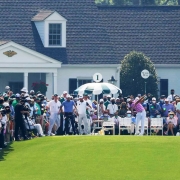
Unfailingly, you’re greeted with a “Good Morning,” or “Welcome to The Masters” by both the volunteers and professional staff each day when you step on the grounds. The security guards say hi, and open doors for you. Members, in their Green Jackets, are extraordinarily polite and accommodating. There are expectations of decorum and dress that might start with the members and the staff, but it extends all the way to the patrons and it’s just part of being there. Nobody has to tell you. Nobody pushes the boundaries of the expectations. And nobody wants to. People just know how to act.

With no cell phones allowed on the course, there are spontaneous conversations popping up on every hole. It’s not uncommon to have the person standing next to you just turn and say, “How’s your day going?” Or “Did you see him hit that? Wow!” And if you’re wearing a watch, expect to be asked a least a dozen times during the day, “Do you have the time?” It seems everybody is so used to referring to their phone for the time, watches are rare, and thus, unique when you’re on the grounds at Augusta National.

I took my normal walk when I was able to when I arrived. While I was in Augusta Monday afternoon, the weather didn’t allow anyone on the course after 11:25, so Tuesday morning I checked in and headed to meet some family and friends by the scoreboard on the first fairway. Some were attending their first Masters, and it’s always fun to accompany somebody who’s seen Augusta National on television their whole life all of the sudden see the grandeur, the gradient and the splendor of the grounds and golf course in person.

“You could try and tell somebody about it,” my brother Gust explained, “But it wouldn’t come close to what it’s really like.” That’s so true. It’d be like trying to explain a rainbow to somebody who’s never seen one. How do you tell somebody that, no, not a blade of grass is out of place? Or that the grass is mowed in one direction on one side of the fairway, and in the other direction coming back?

Up the hill to the clubhouse, it seemed that the first tee was even further back than it had been. We rounded the corner toward the 10th tee and ran into Fred Couples coming off the 18th green. I’ve known Fred since the early ‘80’s, but he and my brother are actual friends, and it was nice of Freddie to stop and say hi.

Heading down Number ten, you could see how much damage had been done by Hurricane Helene as it swept through the Southeast. Not that any trees were broken or out of place, but it was clear that the forest had been thinned out by the weather. Augusta National took care of the golf course, but was also instrumental in helping the city of Augusta get back on its feet. There are still parts of town that are recovering. A big branch from a magnolia tree was hanging down toward the 10th fairway, precariously hanging on to the tree’s trunk as we walked by. By Wednesday, it had been neatly removed as if it had never been there.

“The scope of everything just plays with your perception,” my friend Bob quickly noticed. “You’d have to get your mind wrapped around the thought that ‘I just have to hit this shot’ when you’re playing here.” Bob’s a nice player, so it was interesting to see his perspective from a golfer’s eye.

I could have sworn they planted three trees in the middle of the 11th fairway as I walked by. The National doesn’t comment on changes, but it’s clear they’re asking the player to hit their drives down the middle or the left side of the fairway. No more bailouts to the right and just hitting your second shot over toward twelve tee.

As we walked over to the 13th fairway, my friend Mike kept sliding up the rope trying to see how far back they’d moved the tee after acquiring some land from Augusta Country Club. “Honestly, I don’t know how far back it goes,” he said, shaking his head. “But unless you’re really bombing it out here, it’s a three-shot hole.” Watching two groups go through there confirmed his thought, as everybody laid up short of Rae’s Creek.

The walk back up, across the 14th and 15th fairways and around the 7th green gave more insight to the genius of the design of Augusta National. Certain trees were allowed to flourish toward the fairways at the tops, giving the sense that the landing areas were narrower than they actually are. If you think seven is one of the “easy” holes on the course, know that it’s now 450 skinny yards uphill to a tabletop green surrounded by bunkers. And if you don’t know the green, a six or more will easily appear on your scorecard.

As we walked behind the 8th tee, I encouraged Bob to walk back to the 18th to get a look at the chute the players have to hit their drive through just to hit the fairway. He was gone for a while. “That would be nerve wracking, coming here with the lead,” Bob said, also shaking his head. “You’d just have to say to yourself, ‘I need to make one more good swing,” and hope you hit it out there. Wow.”

The one common comment from all first timers is about the strenuous nature of the walk. Half-way up the 18th fairway, you still can’t see the flag on the green, and everybody stops and says the same thing: “You’d be tired after that walk.” And all professional golfers agree. A survey of PGA Tour players asked to name the hardest walk of the year among the courses they play, named Augusta National almost unanimously.
But of course, Augusta National. At the top every list.

Nobody Saw Him Play

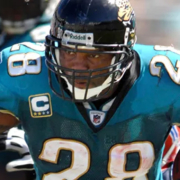
I saw every play of Fred Taylor’s career, live, over the eleven years he played in Jacksonville. I didn’t think that was a big deal until I started researching his numbers and talking to people and realized, not a lot of people saw Fred play.

He was on an expansion franchise that many NFL types considered an outpost, mostly on teams that were mediocre or bad, rarely made a national television appearance, and weren’t regulars in the post-season.

He didn’t have a Peyton Manning or a John Elway as his quarterback. He had Mark Brunell and David Garrard. Byron Leftwich and Jay Fiedler. He didn’t play in NY or, LA or Chicago or for a glamour franchise like Dallas, San Francisco or Miami.

Despite playing on bad teams, and in Jacksonville, Fred amassed those numbers in the National Football League. Even if you never saw him play, he got those numbers against the Steelers and Ravens, the Eagles, the Cowboys, and every other team in the league.

During his career, one offensive lineman blocking for him consistently went to the Pro Bowl and that was Tony Boselli. And that was the first three years of his career. After Boselli retired, Fred’s numbers got better.

But somehow, in near anonymity, he became one of the best running backs ever, ascending to 17th among the leading rusher in NFL history. He gained over 11,600 yards and did that with the second fewest attempts on the list.

How did he do that?

Because every time he touched the ball, he was a threat to score. At 6-1 and 228 he was big enough to run over or through tacklers at the line of scrimmage. Strong enough stiff-arm linebackers and fast enough to run away from any defensive back. Ran a 4.29 at his Pro Day at Florida.

During his career, Taylor averaged 4.6 yards per carry. A pretty gaudy number when you consider only two players in front of him on the all-time list, already in the Hall averaged higher numbers: Jim Brown at 5.2 and Barry Sanders at 5.0. And that list gets more exclusive when you look at running backs who had more than 2500 carries and it whittles down to Taylor and Sanders. (Peterson is the other who’s not in the Hall.)

So how does the anonymity and playing for Jacksonville translate to awards and consideration?

In his rookie year, Taylor had 1644 yards, rushing and receiving and 17 TD’s. Randy Moss had 69 catches for 1313 yds and 17 TD’s. They both made the All-Rookie team that year. Moss won the Rookie of the year voting with 94% of the vote. Fred and Peyton Manning split the other 6%. Why was that? Moss had a big game on Thanksgiving Day, catching 3 TDs against the Cowboys in front of a national television audience. That weekend Taylor played in Cincinnati in a point-to-point broadcast that was blacked out in Cincinnati. Which means it was only shown in Jacksonville. Nobody saw him play.

So, is 16th somehow the cutoff? It would be hard to imagine not putting Taylor in the conversation for the Hall when we talk about “best players from their era.” From 1998-2010, Taylor was the third leading rusher in the NFL, behind LaDainian Tomlinson and only about 550 yards behind Edgerrin James. Despite nearly 500 fewer carries than James. He was consistently among the leading rushers in the AFC, despite 100 fewer carries than the leader each year. He led the NFL in 2000 averaging 107.6 yards per game

I heard Bill Belichick say last month, unsolicited, “Saquon Barkley reminds me of Fred Taylor. And I think Fred’s a Hall of Famer.” Barkley had a monster year this season, dramatically better once he got on a good team like the Eagles.

So, here’s a comparison of their first seven years. And the statistics bear the comparison out:

Barkley 7200 48 TD’s 4.7 yds per carry
Fred 7580 48 TD’s 4.6 yds per carry
Both had 5 runs over 50 yards in their first seven years.

Taylor went on to add nearly 4K yards in the next four years before going to New England.

At the end of the 2007 season Fred carried this pretty average team to the playoffs with nine consecutive 100-yard games, which is 4th all time. Averaged 5.4 yards per carry that year.

When the conversation includes you, and only Jim Brown and Barry Sanders are the others in the conversation, you’re in pretty good company.

Jim Brown thought Fred Taylor was the best running back of his era. Marcus Allen told me the same thing. Troy Polamalu, Derrick Brooks and Ray Lewis said he’s the best running back they played against. Thurman Thomas checked his game against Fred’s every week.

I talked with Tom Coughlin this week about Fred. Coughlin coached in the league’s biggest market, and the smallest. He drafted Fred in the first round in ’98. Coughlin was very animated talking about Fred. He said, “It’s a struggle because of where he played. If he played for me in New York, it’d be a no brainer. The Pro Bowl is a popularity contest, and we all know that. Stop thinking because you didn’t see him on TV, he’s not worthy. Stop thinking because he played in Jacksonville, he’s not worthy. He amassed all those statistics in the National Football League. It didn’t matter how we got him the ball; he was always a threat to score. Easily one of the most dominant players of his era.”

This from a coach who knows the largest media market, the exposure, the national spotlight, and knows the smallest. “In Jacksonville we fight against it, it’s not fair, Fred deserves a fair shot.”

Talented and Good Are Not the Same in The NFL

It still seems backwards.

I’m trying not to let the fact that Doug Pederson is a nice guy color my thoughts about this but Jaguars Owner Shad Khan’s decision to fire Doug and retain Trent Baalke as the General Manager seems like the opposite of what was necessary. In fact, it’s the third of three changes I’d have probably made in Shad’s shoes.

First, I’d have gotten rid of Baalke. He’s a dividing force inside the Jaguars offices. Insiders say he’s tough to work with and creates adversaries among co-workers who are supposed to be on the same team, “A culture vulture,” one Jaguars employee described him as when asked what his problem has been. “He sucks your organization dry.”

From personal experience, Baalke has a lot of hubris when discussing football. He’s almost haughty when I’ve asked a question, the unspoken “given” in his response is, “I’m smarter than you. I know more than you so how dare you ask that question.”

Second, I’d have asked Doug to change both coordinators and stay on. If he said no, I’d have told him he’d have to go as well.

Third, I’d have just cleaned out everybody. But Shad hates paying people not to work, despite it being a fact of life in the football business.

Apparently, Khan never considered a clean sweep. Listening in on the Zoom press conference Shad and Baalke held on Monday afternoon, Khan expressed a lot of confidence in their “organization.”

“I’m not sure what you mean by ‘clean sweep,’” Shad said when asked if he considered getting rid of everybody. “We have eighty-five people in the football organization who are doing their jobs. What? You’re going to go out and find eighty-five better? Overall, our organization is pretty good. We need to fix what needs to be fixed now.”

Baalke chimed in, “We don’t need to fix everything, we just need to fix some things.”

Hubris and smugness are the usual downfall of most leaders who don’t last, and it won’t surprise me if that’s Baalke’s eventual Waterloo as well. But for now, he has Shad’s confidence.

And that could be part of the problem. A meeting among the staff last week brought Shad a consensus that a full reset was necessary. But he disregarded that, apparently, he doesn’t have enough confidence in the opinion of the rest of the people in the building.

Khan talked in the presser about Baalke’s “Body of work, the metrics, the salary cap and how he leaned on other NFL owners, and people in the NFL organization to help him come to the conclusion that Pederson had to go.

And that breaks it down to its essence. It’s not those things that make a winning organization. It’s culture and leadership. The Jaguars are the most talented bad football team I’ve ever seen. Baalke has shown he can evaluate talent; he hasn’t shown he can build a team.

Former Jaguars Head Coach Tom Coughlin, a two-time Super Bowl winner with the New York Giants explained that to me in 2000.

“You’ve got the top of the roster. Those are the players you expect to make the play ten out of ten times. When the game’s on the line, you want the ball in their hands,” he began. “And some of them are leaders who set the culture and tone for the rest of the team.” Think Tony Boselli. Paul Posluszny, Calais Campbell or even Leon Searcy. Would you get in a fight with Leon? I think not. Any starter on this Jaguars team willing to wave Jason Taylor down to the other end of the field on Monday Night Football a la Boselli? No.

“In the middle of the roster you have the spot starters, those who are going to make the plays most of the time and can perhaps develop into ‘top of the roster’ players,” he continued. “They’re subs, stalwarts on special teams, guys who push the starters to be better.” Here’s where Gary Walker, Lonnie Marts and Tom McManus come to mind, although they were mainly starters. Dewey Wingard is the only guy on the Jaguars roster who fits this description.

Then he got to the crux of building a team, without perhaps even knowing it.

“At the bottom of the roster, you have guys who are very talented, great athletes, or they wouldn’t be in the NFL. But they didn’t make it on talent alone. They have grit, they want to mix it up. They’re the tough guys, the ‘stand in the hole and make it hurt’ kind of players. They’re in the weight room competing. They end up holding everybody else accountable for their toughness. Football is a tough game.” There are dozens of former Jaguars who fit this description. You could put McManus in this slot, Jeff Kopp, Montell Owens, Brant Boyer.

The Jaguars have a lot of top of the roster guys, but none are the leaders or culture builders they need. They have some middle of the roster guys. They have zero bottom of the roster guys.

To build a culture you need continuity. Ever notice how the Pittsburgh Steelers always seem to have the same guys, just different names? Greg Lloyd is James Harrison, just with a different name. Mike Tomlin sets the tone for that, and the Rooney family has preached continuity forever. In the last fifty-four years, they’ve had three head coaches. Three: Chuck Noll, Bill Cowher and Mike Tomlin. And Tomlin has never had a losing record. What’s that tell you? He demands the players meet a certain standard. You don’t fit, you’re gone.

Look what Dan Campbell has done in Detroit. He only accepted tough guys on his team, from the starters on down. When you watch them play, they hit, they play with a sense of urgency we haven’t seen since 2017 and rarely before that as well.

Hiring a new Head Coach for the Jaguars will be tricky with Baalke in place. Khan didn’t answer the question directly when asked if the new head coach would report to him. “Doug reported to me, Trent reports to me, that worked,” was his answer.

I did like some of the things Shad said but can’t decide whether they were talking points put together by his PR team or what he actually thinks.

“We’re the most predictable team in the NFL on both sides of the ball,” Khan said about why he made a coaching change. He’s right about that. “We were twentieth in the league on defense last year, this year we’re last. Part of success in the NFL is deception, and we need that.”

What about if a coach comes in and says the Jaguars need to revamp the personnel side? “We have to create an environment for them to be successful. If we can get better, I want to listen to that. I know we can improve.”

And what’s the pitch to a new Head Coach? “We have a compelling case to offer somebody as our head coach,” he responded. “The personnel, the facilities, the health and wellness of the players. We’ll interview them and they’ll interview us. I want to make sure this isn’t about ego or power. If it’s a legit effort to get better, everything should be on the table.”

And what about hiring an Executive Vice President as part of both the personnel and football sides of the organization? “We’re lean. We need to add some people. But we need to identify the right people.”

You don’t have to look far Shad. Hire Boselli. Get Ben Johnson. Bring Mark Brunell as the offensive coordinator.