The Players: Everything, Everywhere, All at Once
It started off with a few guys sitting at Silver’s Drug Store talking about having a golf tournament. It’s been called the Greater Jacksonville Open, the GJO, the Tournament Players Championship, TPC, The Players Championship and The Players. It’s been known as a destination, a reunion spot, and for the Swingers Tent. And I once called it a love story. Whatever you call it, and however you view the golf tournament played here in town every year, when you attend you realize it’s everything, everywhere, all at once.
When then-PGA Tour Commissioner Deane Beman was looking for a permanent home for the Tour’s flagship event, Jacksonville’s volunteer force impressed him and after a failed attempt to buy Sawgrass Country Club (along with Marriott) the Fletcher Brothers offered the land for a golf course and headquarters across the street for one dollar and the opportunity to develop the property around it in the future.
All of that is well documented in articles, TV stories and books over the past forty-five years since the tournament found its permanent home. And while Beman was looking for a spot for a premier and perhaps a major golf tournament, people in North Florida had a whole different idea.
With the tournament in Pensacola going out of business, the founding group here of the GJO, (John Tucker, Wesley Paxon and others) recruited the guy running the event in the Panhandle to handle some of the nuts and bolts of the competition. The Tour wasn’t fully formed at the time, but the standard stop was played at a country club somewhere, with the members of that club running the show. The group here though, had other ideas. While they chose Selva Marina as the initial venue, (with stops at Deerwood and Hidden Hills along the way) they decided to get clubs and golfers from all over North Florida involved. Most were members at San Jose Country Club, but they invited some of the players at Timinquana (a big rival at the time) to join the process. They recruited the golf associations at Sawgrass and other clubs in the area to be a part of it, truly a GREATER Jacksonville Open.
Soon a car dealer donated vehicles for the week for the players. Steel posts and rope were donated for crowd control. They built hospitality tents, unheard of at the time, to entertain clients and friends.
And word got out.
Much like the Florida/Georgia game, the competition on the course bred a cultural happening.
While the initial stops of the GJO have their share of stories (a well-known, contending golf professional with a late tee time on Thursday emerging from the bushes at Deerwood for his early tee time on Friday wearing the same clothes) and Sawgrass Country Club earning a reputation for its difficulty the first week of March, it wasn’t until the tournament moved to its permanent home in 1982 that things started to change. Tucker, held over by Beman to oversee the transition from GJO to TPC, had big ideas and the tournament started to expand.
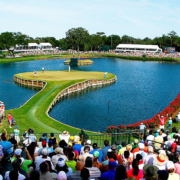
Using the PGA Tour’s leverage, instead of a local car dealer providing vehicles, it was the major manufacturers who jumped on board. Priding itself as the “strongest field in golf,” it didn’t hurt that Jack Nicklaus was a three-time winner of the event and the best players in the world showed up year after year. The seventeenth hole gained an international reputation. Test or gimmick? The tour didn’t care; people were talking about it. CBS had the most recognizable golf coverage with Pat Summerall and Ken Venturi anchoring, giving the tournament even a higher stature.
Beman didn’t like the competition for TV space with the NCAA’s March Madness, so when the TV contracts came up, NBC offered to showcase the event as one of their biggest. More hospitality tents popped up around seventeen and eighteen. Then sixteen and beyond.
There was a conscious push to make The Players a “Major”, but the golf establishment balked. So being the first “significant” tournament seemed to be enough for a while. Tucker was replaced by Henry Hughes, a PGA Tour insider from the Northeast, and you could feel the tournament becoming less local and more a part of the Tour’s “Championship Management.” While the city of Jacksonville was engaged for a while (a replica of the seventeenth hole was erected at the Landing) eventually the new Commissioner Tim Finchem wanted to raise the TPC’s stature internationally. Ads for attending next year’s Players dotted the NBC broadcast. There was no mention of Jacksonville and little coverage of the beaches and surrounding area. The focus was on the golf tournament. PGA Tour Blue covered every tower and structure you could see, mimicking Augusta Green at the Masters.
But Jacksonville and North Florida sports fans wouldn’t stay away. People who had never watched golf and certainly had never been on a golf course found their way to Ponte Vedra for a day or two. Friday afternoons became a “must attend” for single men and women gathering behind the seventeenth and eighteenth greens. Outfits and sun dresses were picked out, the right logo on the golf shirt was part of the decision making, and no work was getting done in town on Friday of TPC.
Grounds tickets were fine, and available, but all of the sudden, “Benefactor” tickets were all the rage. More hospitality tents surrounded the amphitheater at sixteen and seventeen, even changing how the seventeenth hole was played. The wind was still there, but you couldn’t feel or see it unless you looked at the flags on top of the tents surrounding play.
Tuesday became a hot day at the Tournament. Originally billed as Military Appreciation Day, President George H.W. Bush attended once, followed by a concert. Top artists like Toby Keith were recruited and the event shifted from the clubhouse lawn to a barge in the lake at seventeen. Throngs of people started showing up for the concerts and the acts became the Tuesday focus. Darius Rucker, having left Hootie and the Blowfish and turned country, was a headliner. Looking to broaden their audience, the Chain Smokers were booked and this year Ludacris cleaned up some of his songs and expanded the fan base even more.
The Tour came to its senses and re-engaged with the city, realizing that local ticket sales were the lifeblood of the tournament. Local vendors were asked to join the party. Fun names like “Wine and Dine on Nine” and “Tacos on Twelve” became tournament buzzwords. Vodka brands competed for a spot on the grounds as the “official” vodka of The Players. Commissioner Jay Monahan help fold The Players back into the community.
It doesn’t matter where you go on the TPC’s Stadium Course during the tournament, something’s happening there. From the first tee to the ninth green, from the tenth tee to behind eighteen, there’s a buzz, sometimes audible, but always with an undercurrent of just being there. They’re keeping the actual number under wraps, but about 50,000 fans fill the grounds hole after hole. Perhaps they’re limiting the ticket sales, but for the first time, the Tour declared Friday, Saturday and Sunday sell outs in 2026.
New PGA Tour CEO Brian Rolapp, a veteran of the NFL’s ‘nothing but the best’ culture, has been impressed with the whole operation of The Players according to Tour insiders.
Maybe somebody should tell him about the GJO, the TPC, the history of the tournament and how Jacksonville and North Florida works
He wouldn’t be surprised.