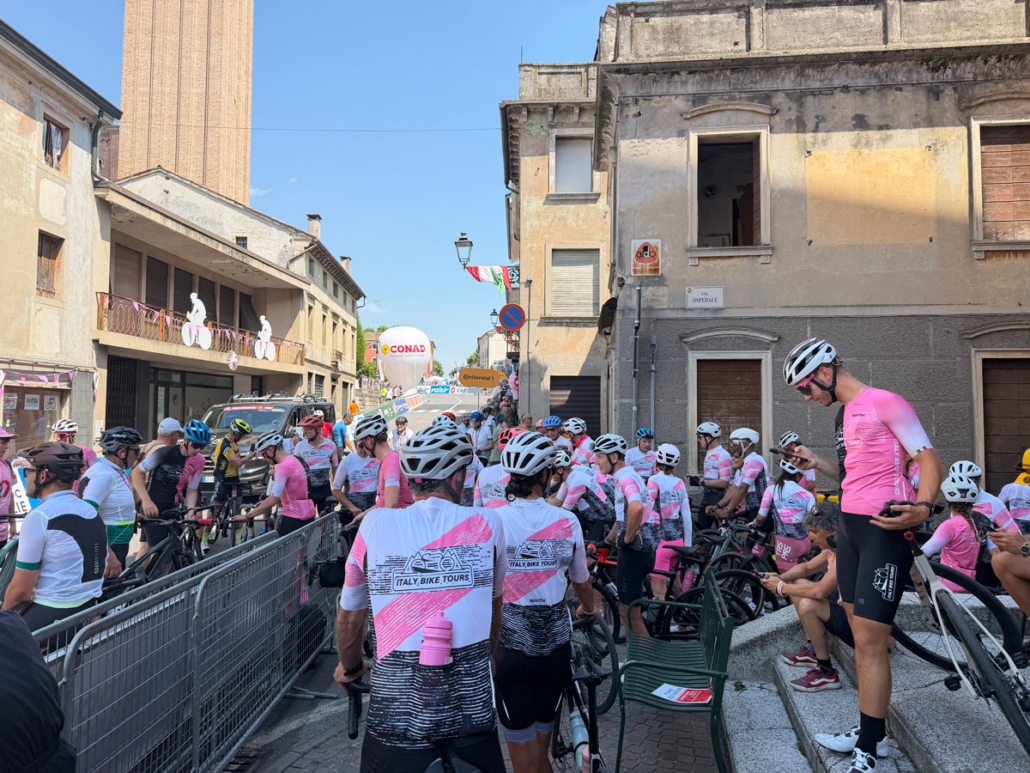
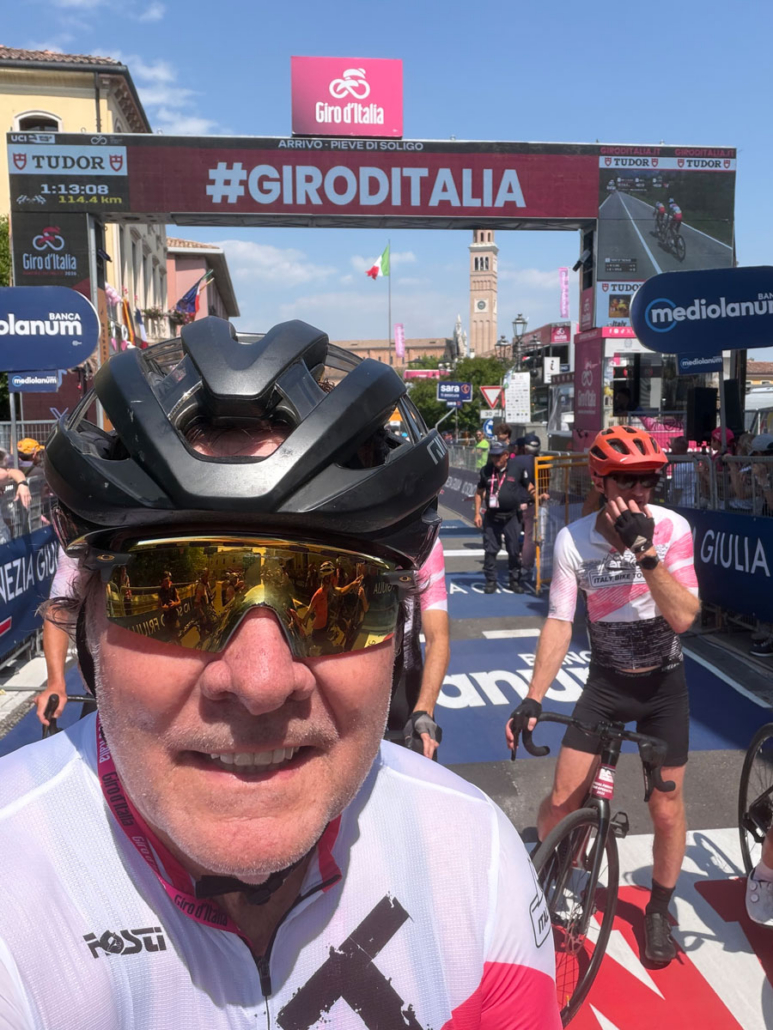
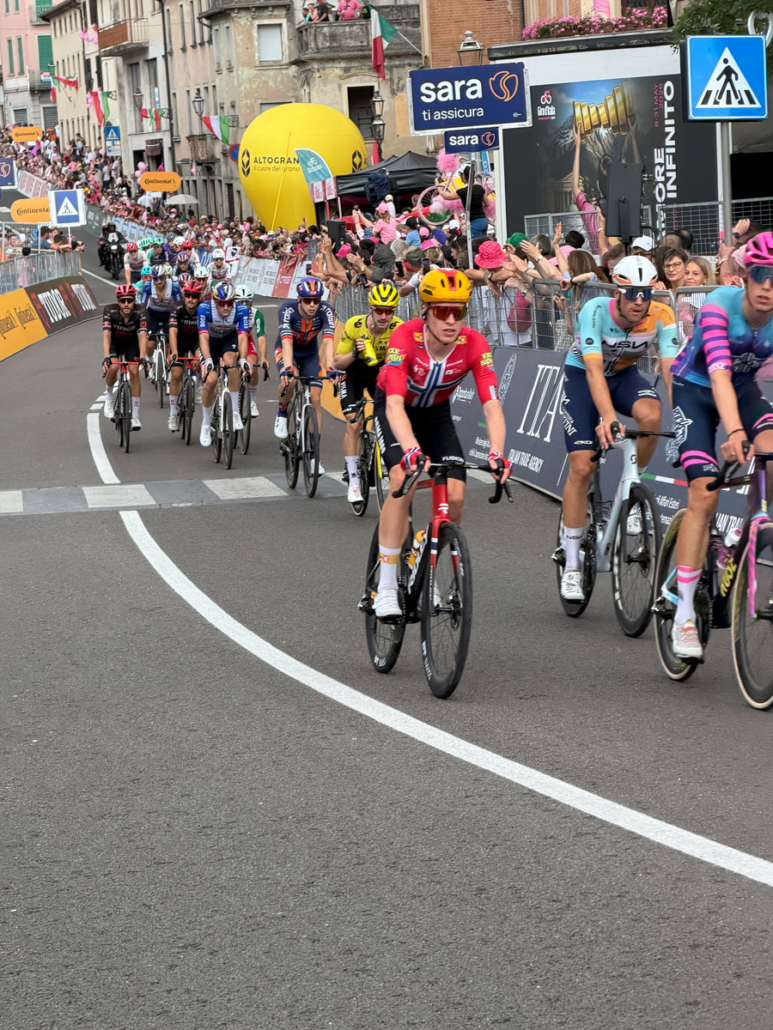
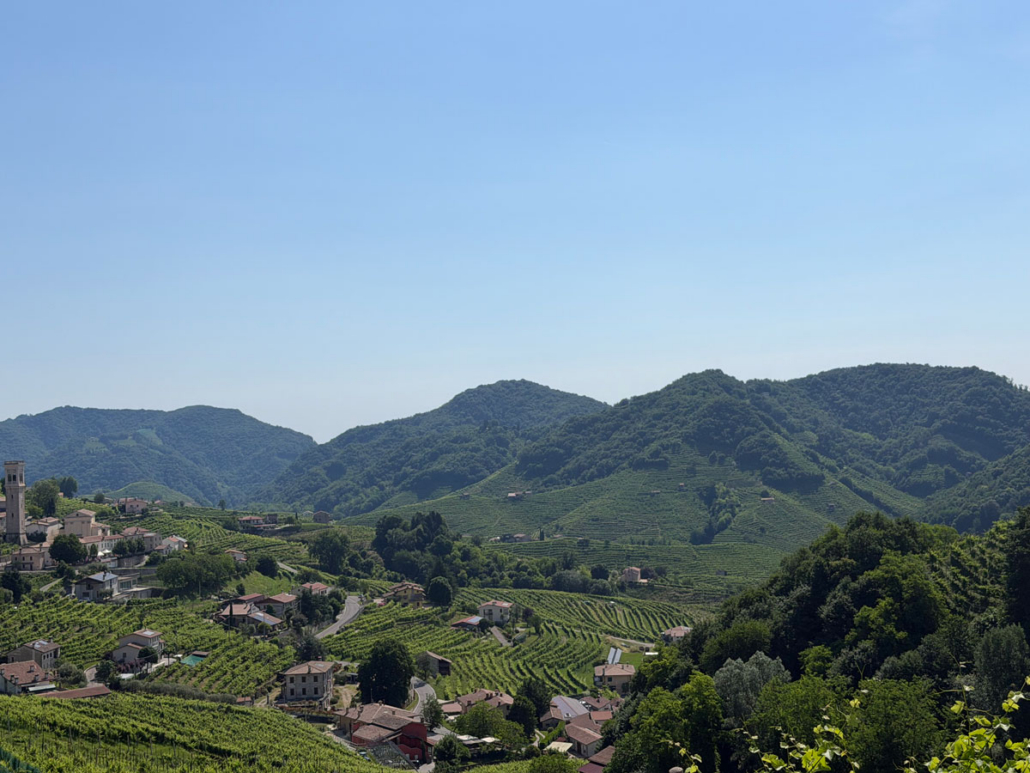
After four joint replacements and other physical ailments over the past 7 years, I wanted to go on a bike trip this year to see how my body reacted. As some of you know, I’ve ridden my bike around the US and in several countries in Europe, sometimes just going on a trip with friends or family and others involving the big international races. Riding in Italy has always been one of my favorites, so I asked the guys at the bike shop and my friend Dirk if they’d like to come along. The guys at the shop all seemed to be busy (and they went to Belgium last year) and Dirk didn’t see much hope in going as a fairly newlywed, buying a new house, added responsibilities at work and his wife taking a new job.
But clearly, he married the right woman because the conversation apparently went like this:
“I was talking to Sam about going to the Giro this year at the end of May and …” he opened with.
“You have to go,” his wife immediately responded. “You know you guys are not getting any younger.”
That was a kind thing to say, considering Dirk is a better rider and younger enough than me to make a difference. He did have an ankle issue earlier this year that kept him off his bike, but he’s still plenty proficient.
So, when his call to me started with, “I guess we’re going to the Giro,” our research began. Dirk is good at ferreting out potential companies, and we settled on Italy Bike Tours.
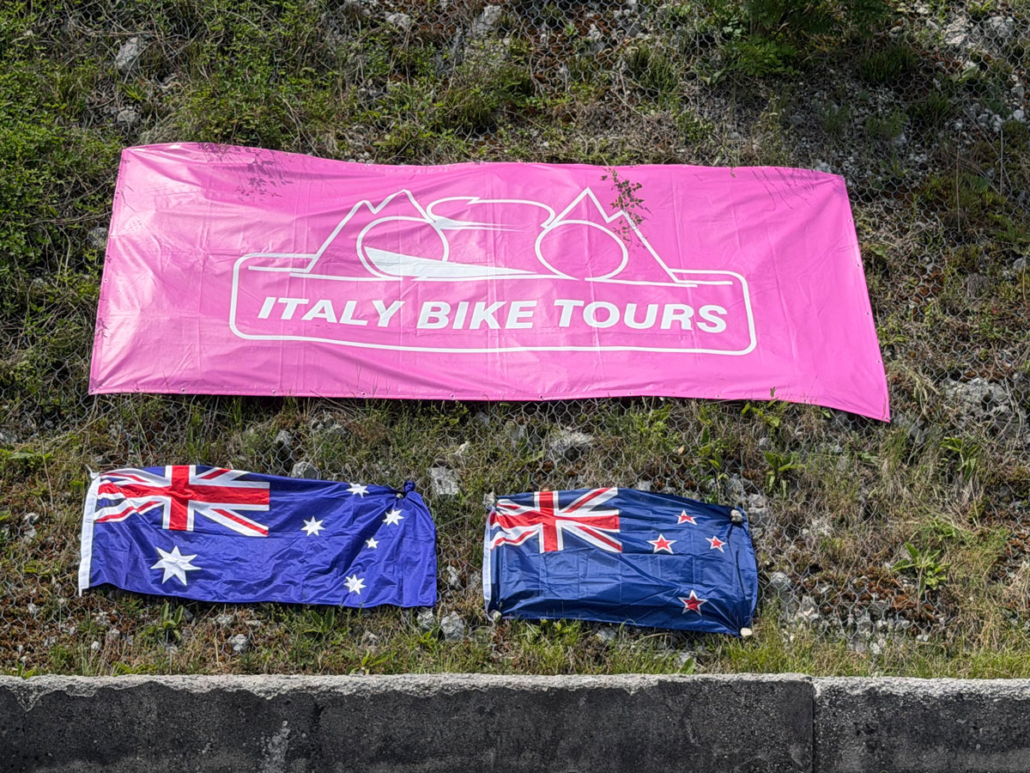
They have an alliance with the Giro (www.italybiketours.com) and while parts of the three-week Giro-adjacent trips were sold out, we got in on the “Last 12 Days of the Giro” starting in Milan and finishing in Rome.
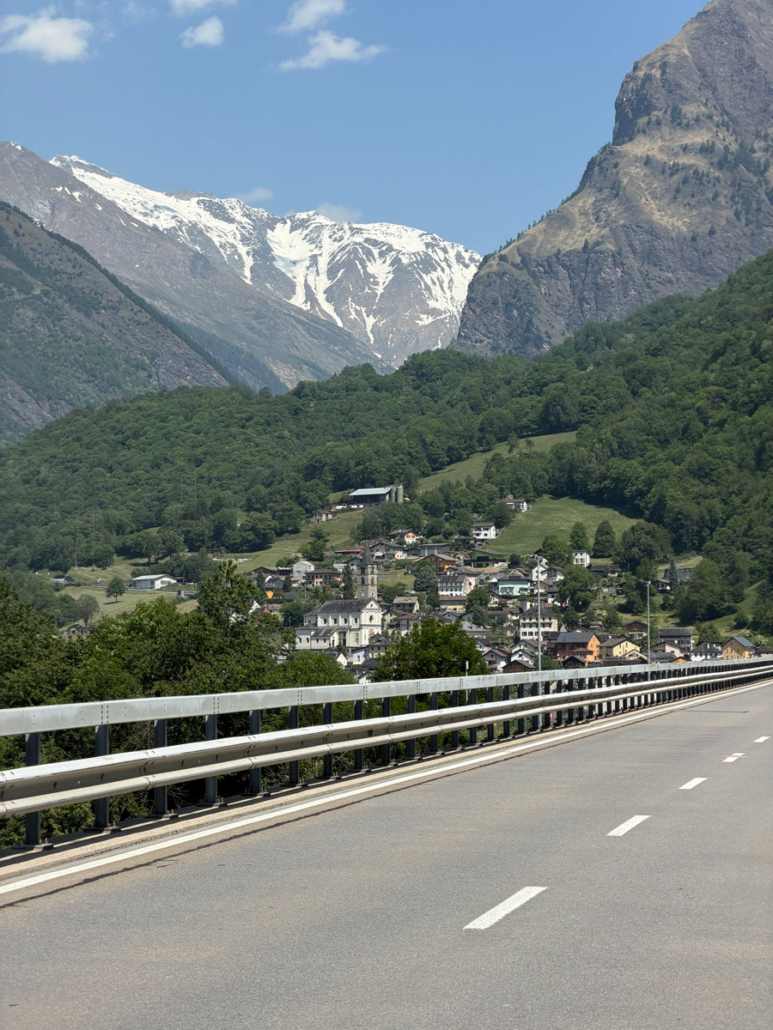
We opted not to go to Rome, so our riding would all be in Northern Italy, around the famous lakes and in some famous wine regions, including Piedmonte and Veneto. That part of the Giro was scheduled to go through some of the most iconic scenery, climbs and routes most cyclists know about in Italy and Switzerland. The trip seemed to be a good value with Italy Bike Tours offering transfers, riding, hotels, hospitality and a bunch of meals throughout the twelve days.
It would be a good test for me. I was cleared to work out and ride my bike at whatever level I wanted just five months ago, so my fitness level has suffered a drop-off in the last decade and honestly, I’m carrying a little more weight than I’d like. (Cleared, I’m working on that! I can tell you at seventy, it’s harder to shed pounds than it was at sixty and a fifty and … well if you have any years on you, you know what I mean.)
I’ve never been a particularly fast rider, although I can keep up in a Florida peloton on flat roads, and I’ve always been too big (usually 6’3” 235) to be a climber. But I do like to ride my bike and the culture in the cycling community. Before my first joint replacement, I told my surgeon, John Redmond (who is the best btw), that I’d give up all the rest of the crazy physical stuff, but when the rehab was over, I wanted to still play golf and ride my bike with my friends. He promised I’d be able to do both. I am getting back to better golf, and this trip would test his theory. Over the years, I have found the one thing I’m good at on my bike: stamina. I can pretty much go all day.
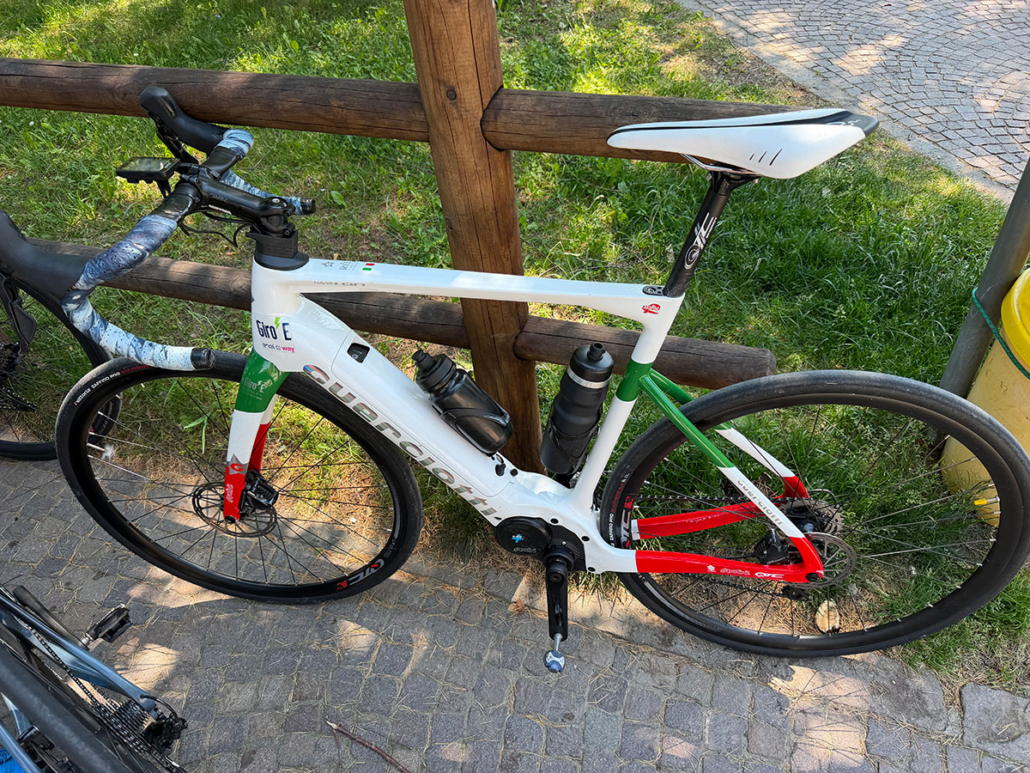
Knowing these limitations, I decided for this trip (and maybe in the future) I’d rent an e-bike to help me along. I’ve thought that development in cycling technology would keep me in the sport longer when it first came out. I know it sounds wimpy, but I’m on vacation and wanted to enjoy myself! Besides, e-bikes don’t go anywhere unless you pedal them, most with a torque meter in the crank, giving you an assist based on how hard you’re working.
Funny thing, Dirk agreed immediately. “Thank God,” he said with a laugh.
Choosing Italy Bike Tours turned out to be a master stroke of luck. I’ll start by saying, they’re fabulous. (I paid full price for this trip, so my endorsement is genuine.) I’m sure it’s hard to be a tour operator to begin with, but designing a bike tour around one of the Grand Tours involves a lot of logistics and a lot of unknowns. The route of the Giro changes every year, so they have to wait for it to come out, usually in November, to start their planning. This year, the Giro was negotiating with Bulgaria about the price the country would pay for hosting the start and the first three stages, and that dragged on until nearly Christmas. So IBT, and everybody else, was scrambling to get things planned and offered to the public.
The twelve day trip turned into fourteen trying to deal with the airlines and with an expected day in Milan to visit with Dirk’s friend Lucca. Delta Airlines (www.Delta.com) was unreliable as ever, getting me to New York late. Exactly why I decided to go a day early. The following day we inventoried our gear, had a pastrami sandwich for lunch and headed to JFK. The transformation of LaGuardia from the worst to possibly the best airport in the US can only give us hope that the same authority is going to do the same at Kennedy. The new Delta One lounge there is fabulous, but otherwise, I don’t like flying out of there. After an hour and forty minutes in a $125 Uber, we walked the normal mile to get to the Emirates check-in for our nonstop to Milan.
From everything I heard about Emirates, (www.Emirates.com) I was excited to fly in one of their flagship Airbus 380’s. I have to say the check-in process at their counter was less than what their standard proclaims. True to form, JFK TSA walked us out of the line and downstairs to another line. Only amusing because it was just as long as the first line. I have Clear (www.clearme.com) that I never use and it actually came in handy. A stop at the AMEX Centurion lounge was pleasant, despite the lengthy QR code on your phone sign-in process and a wait.
When I bought my ticket and booked my seat, it showed a bunch of open space in front, much like an exit row. In reality, there was a bulkhead, so I spent the overnight flight trying to get comfortable. The seat itself in Premium Economy was better than that class in any other airline I’ve flown, but so far, Emirates is in line with everybody else. Perhaps I’ll book a business class seat next time to compare.
After looking at a million hotels in Milan, we had reservations at the Marriott property Duo Porta Nuova, a Tribute Portfolio Hotel (www.marriott.com). I was surprised at how much I liked the whole place. Outside dining, fun vibe. We headed down to the center of town to see the Duomo and just started walking to look for a place to eat. Most times in Italy that works out, and it did again on this night.
Italy Bike Tours sent their van and Stefano to pick us up the next day. We picked up another couple from New Zealand on the way out of town. When I asked Stefano if he rode, he said, “A bit. I’m the photographer.” Over the next few days, I came to realize, he might be the person charged with chronicling the trip, but, like everybody we’ve met, he can really ride.
Our lead guide for our group, Nicola, (nicknamed “Gaffu,” part of his last name) was excellent in every category. He laid out what the next day would be like, he was respectful and helpful in every way, and as a logistician, he was on top of it, a real pro. Clearly, he was also respected by the young guys working for him. His leadership was on display every day by the way they responded to him regarding every task: handling the bikes, the luggage, the riding, whatever was necessary. The two primary guides working for him, Julio and Nikolai were fabulous riders, charged with either leading or trailing the group, checking on how you were doing, pacing you up a climb or back to the group and just generally were good guys to be around. We had some experience with some of the other guides and felt like we drew the right guys for us. Add young Pietro to the group, learning the business, and Mirco handling the bikes and the vans, the coordination between all of them was impressive. Anita was part of the group working with us, but she was mainly in charge of the non-riders, so we didn’t interact with her much. But when we did, she was organized and helpful. And they all were cheery, as if they had been trained to be in the service business! It’s what I hope all people who get to ride bikes and travel around the country for half the year would act like.
Our first hotel was a farmhouse “resort” outside of Milan (villaraggi.it). On arrival the guides were already working on bikes with the mechanics and getting everybody settled. We saddled up for the first time and rode out to pick up the finish of the day’s Giro stage near the hotel. It was fun to see the riders go by, standing right on the side of the road. An easy ride back finished the day with a nice dinner included at the hotel. Gaffu laid out the week and gave us the schedule for the next day. IBT also uses the WhatsApp platform to let everybody in the group know what’s going on.
There are eighteen of us in the “Last 12 Days” group, evenly split between some Americans and Australians, with some New Zealanders and Canadians involved as well. We’ve overlapped with the group that’s already been there for week two, and we’ll get to know the week three people next Monday.
On Day Two we had a two-part ride. We rode to Alessandria to see the start of the Giro stage, then hung around there before going to a winery/vineyard for a wine tasting and a tour. Very nice. The break between rides was too long and I got comfortable, and stiff, so it took me a while to get into a rhythm in the afternoon. As I mentioned, Dirk and I made a pact to go with an e-assist bike on this trip. We’ve done all the hard stuff, so we were giving ourselves a break. Funny thing is though, there’s a law in Italy and throughout Europe that at 25 KPH, (about 15 mph) the assist cuts off. So, if you’re going to try and go any faster, you’re dragging this heavy (22 kilos) bike along. With the first two days just being flat rides, it was a lesson learned.
In Italy, they were way ahead in the “Farm to Table” restaurant culture. That’s always been an option for dining throughout the country in places called an Agriturismo, a farmhouse for dinner. IBT set one up for us that night and sitting at tables for ten, we were all in a large barn where the sides had been taken out and replaced by floor to ceiling windows. Chandeliers and white tablecloths set the place off as an interesting juxtaposition of a dining experience. The food was great, but something must have happened in the kitchen as the first three appetizers came out in short order, but it took nearly an hour for the main course to be served. But it wasn’t like it sat there on a warming tray. It was hot and delicious, but it took a while.
We transferred to Lake Como on Day Three, a two hour morning drive. I’ve actually ridden around Lake Como before, so I was looking forward to the day.
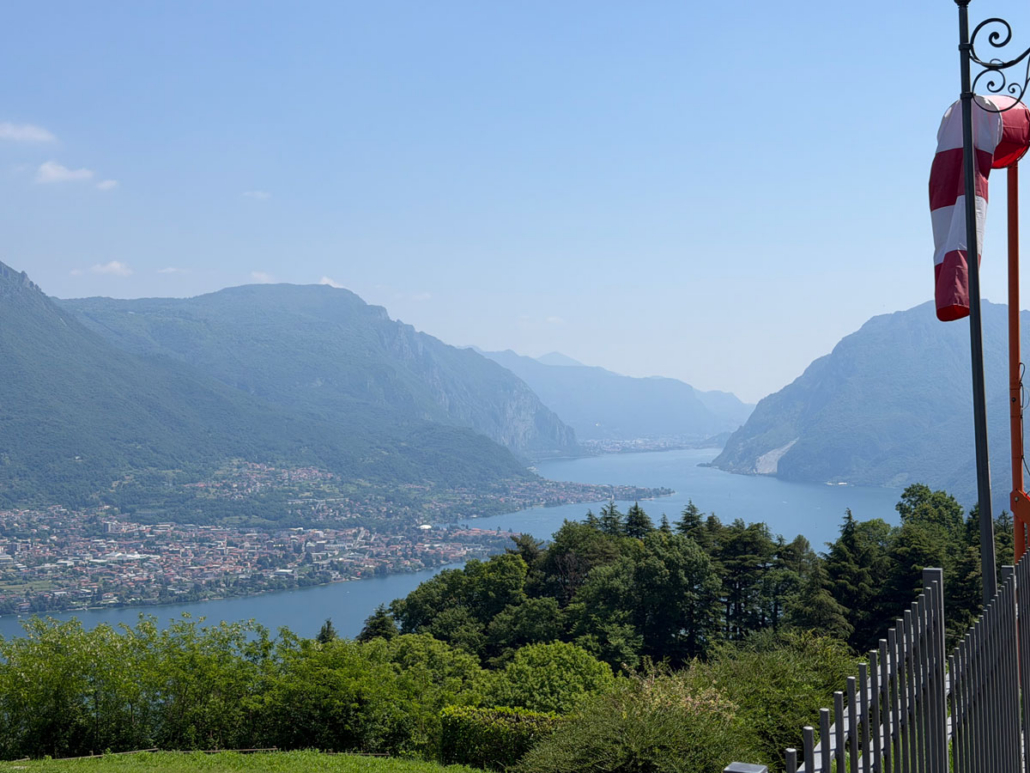
We immediately got on our bikes, and this is why we went for the e-assist. Heading out of the parking lot of our new hotel as a group, the route immediately headed up the hill toward a ridge on the east side of the lake. Riding through village streets, and competing with the regular traffic took some concentration, and it was uphill. Not much, but definitely uphill. A left turn took us over the top of the ridge and suddenly the lake spread out before us. I was riding with one of the young guides, Julio, who told me it was his first time riding there. “Wow, beautiful,” he said in English as we chatted about how lucky we were to be there that day.
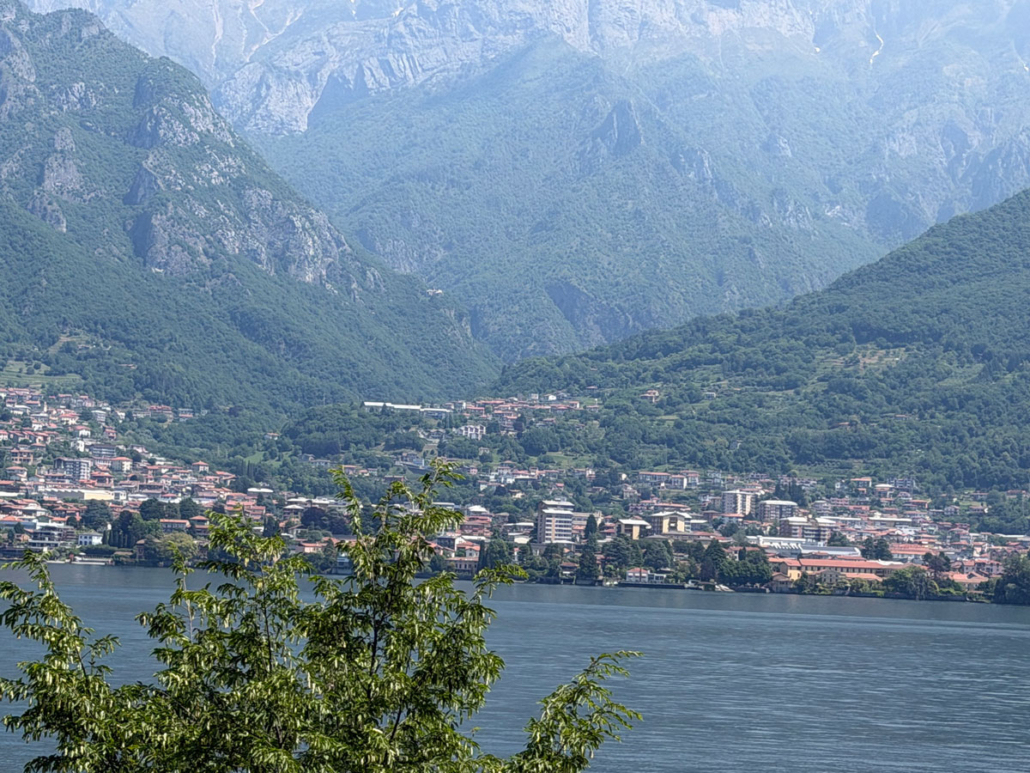
We worked our way around the outskirts of the lake and eventually climbed up over a second ridge and started a descent toward the shoreline. I’ve tried to describe what Como looks like the first time you see it and the best I’ve come up with is “like a fairytale.” And it doesn’t disappoint every time you see it. A sweeping left hand turn revealed a wide, magnificent vista of the lake that is literally breathtaking.
We stopped on the side of the road to take in the view and while some in the group continued down the hill to the town of Bellagio, some of us turned left and headed up the climb. Having done this before, not with any assist, I didn’t remember it being as difficult and steep as it was. My bike battery quit more than 1K from the top so rather than choose the option of 1) crying or 2) turning around, I just turned it off and stomped on the pedals to the top. Luckily, I remembered that I was close and knew it was worth the effort.
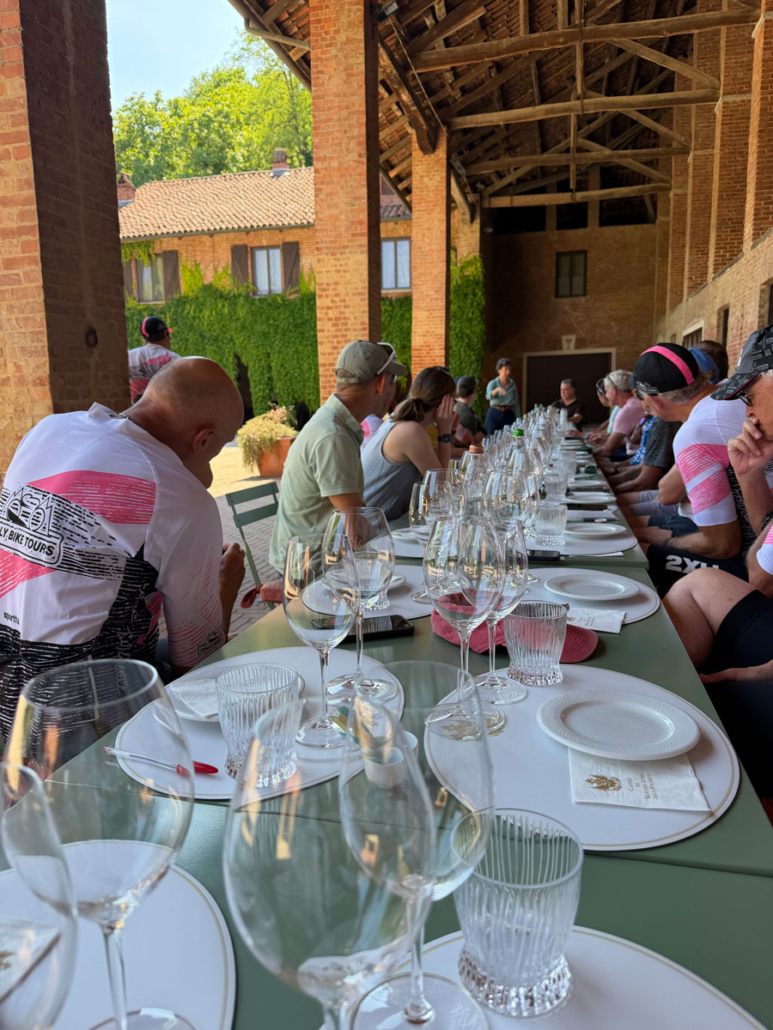
Surprise, surprise, Dirk and I had a coffee at the top, then walked over to the museum. IBT had set up a nice reception area in the garden with snacks and drinks, so we hung out there for a while before joining a private, group tour. The tour guide really knew the museum and the lilt of her Italian accent while she spoke English made it even more authentic. Is that the best bike museum in the world? I don’t know, but if you like bikes and bike racing, they have it all.
Since it was Saturday night, Gaffu encouraged us to take the vans into Como for dinner on our own. He was right. While you could say it’s been overrun like a lot of tourist spots in Italy, you really got the whole vibe of the place on a Saturday night with all of the locals making their way into town as well. We ran into some of our riding mates while strolling and laughed when we realized we had randomly picked the same restaurant (La Storia), but we were sitting around the corner from each other outside. The owner came out and explained that the building had been there since 1200, and the restaurant had been in business since 1901. Our server spoke English like an American, (“I learned watching TV.”) and as usual, the food was fabulous. It looked like the kitchen was in the weeds, so the main course took a while. But again, hat and delicious.
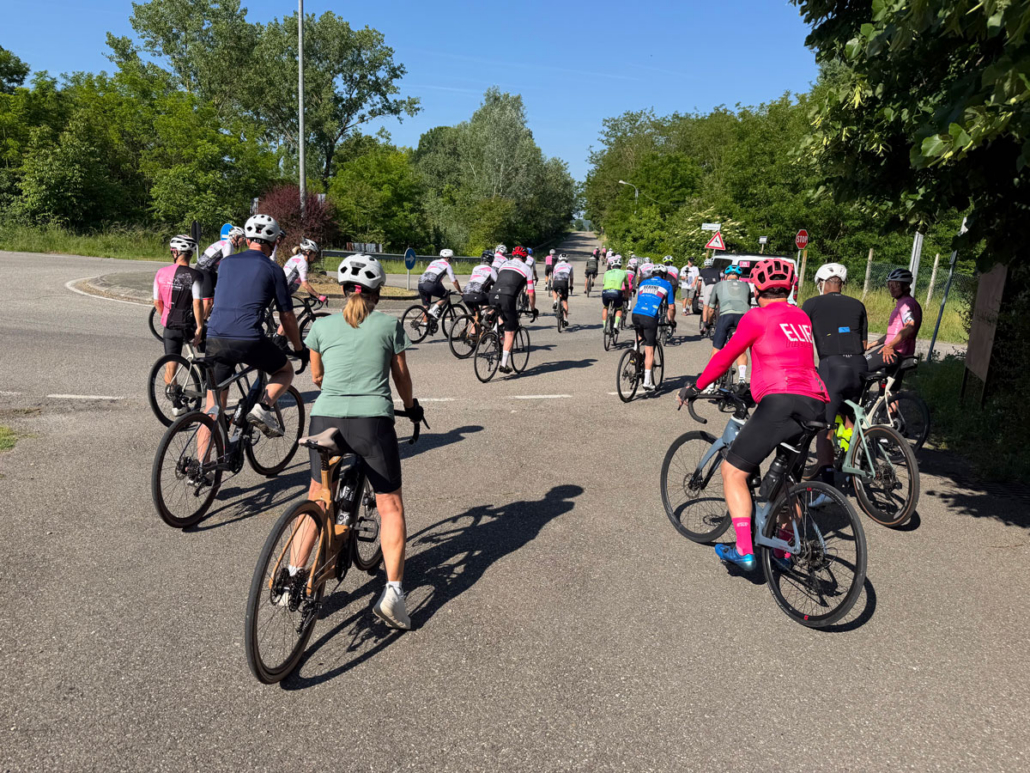
An earlier start on Day 4 than originally promised but we were in the vans at 8:45 for a 45 minute drive toward Milan. The “long” ride of about 50 miles left at 8:30 with the intention of joining up with us for a parade across the finish line of the stage in the middle of the city. Just before 10, the rest of us saddled up and headed down some steep switchbacks from the parking lot we were in toward the river. Along the banks of the Adda, it was a dirt path that turned into a tooth chattering section of gravel, concrete and washed away bare sections. At least it cleared the wax out of my ears. I was glad to finally hit some paved sections, only to be greeted with a beautiful Sunday afternoon crowd also using the path for cycling, roller blading, walks with the friends and families and everything else. In both directions. So, you had to stay sharp on your bike. After a short coffee stop (that’s one other great thing about Italy, they’ll serve you great coffee at a moment’s notice) we made it into the center of town ahead of the stage finish of the Giro.
The two groups met up about 200 meters from the finish line and cruised down the barricaded section to the cheers of the crowd. We also were invited to the podium where we took group and individual pictures. Italy Bike Tours (IBT) has been associated with the Giro since 2018, so this was one of the nice perks.
We were instructed to bring a change of clothes, and this is one funny thing about bike trips. While you wouldn’t think of doing this on almost any other day, we all took turns changing into street clothes from our cycling kits in the back of the van. I at least brought some deodorant, but I’m not sure it mattered. The whole city was packed with people in town to see the race. The final 25K or so is three long laps around the city with the final 500 meters a long straightaway. Again, IBT used their relationship to give us VIP hospitality access at the finish line, so we all took advantage of that. Dirk and I walked down the street and had an unexpectedly delicious lunch at an art museum cafeteria and were back to the finish line for the end of the race.
Somebody miscalculated how early the peloton needed to gear up to catch the breakaway, so the excitement of them closing the gap, only to be held off by under a half minute kept the crowd guessing.
A group dinner awaited back at our hotel at Lake Como. We bid farewell to the people we overlapped with from the week two Giro trip and our dinner table was filled with about a third of the group staying, as well as a couple of our guides. The food was fabulous (again), and it was great to talk to fellow riders from Australia and the guides from Italy about how we all got here together. Our group is dropping down to about 18 and we’ll co-mingle with the third week group on the roads the rest of the week.
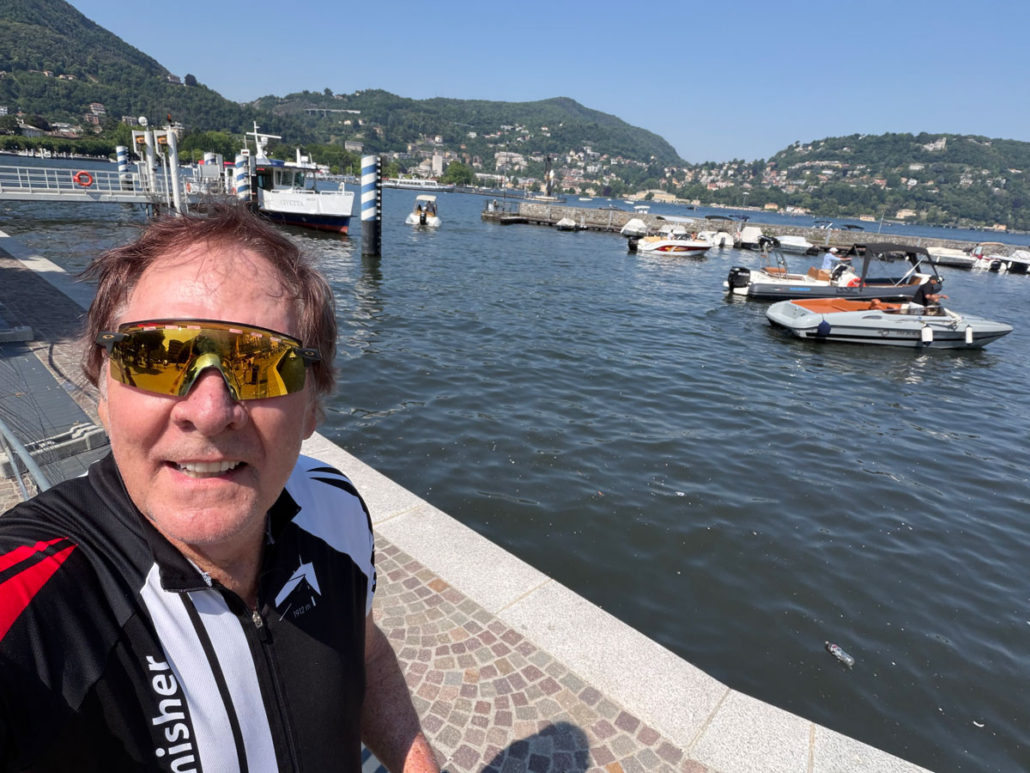
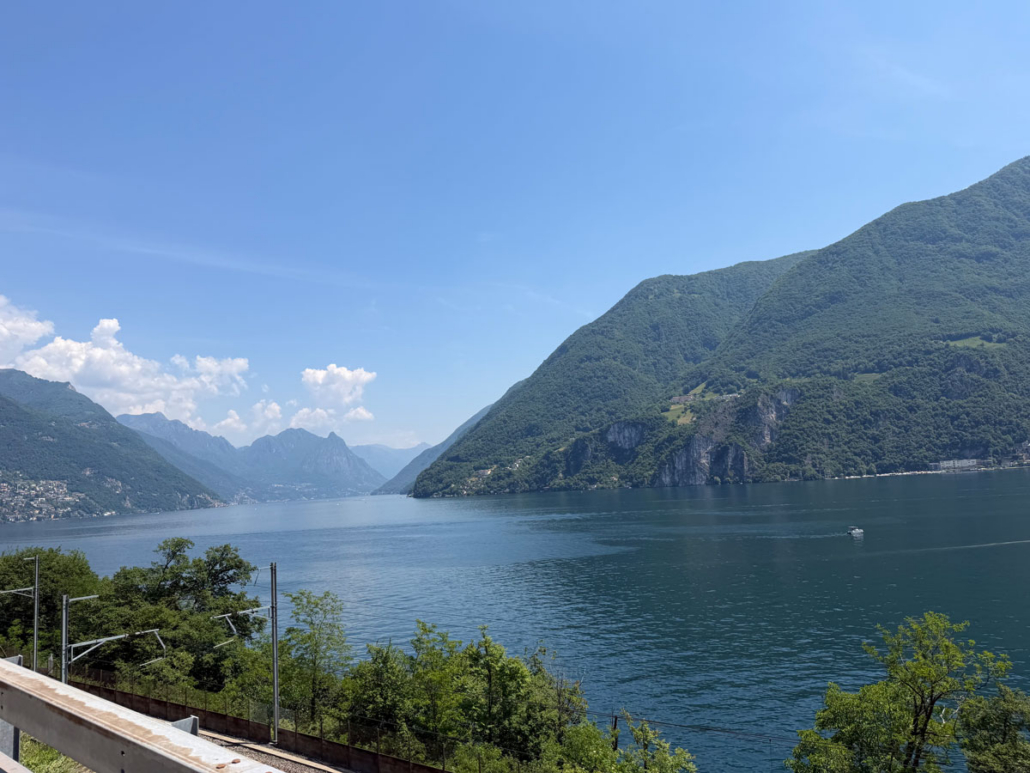
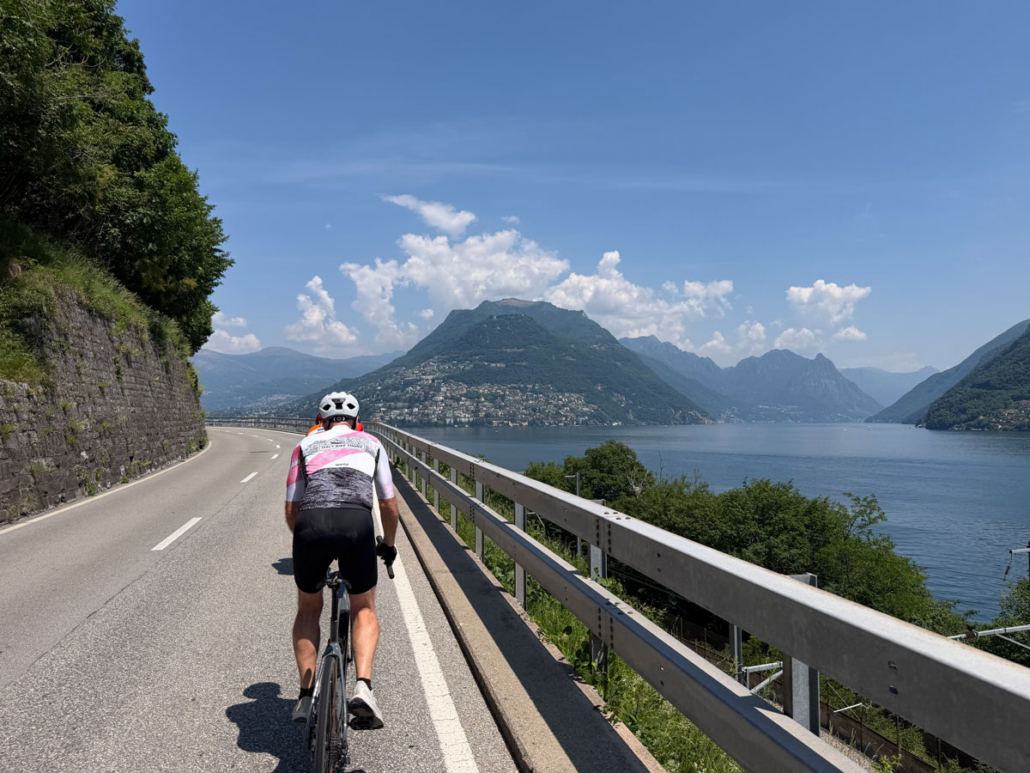
There are some challenging days of riding and transfers that are always a part of any extended bike trip. Our next day was one of them as we left our luggage in the vans and rode out of the hotel on our way north. The fun part was the ride back into Como, for a coffee stop of course, and then up and around the west side of the lake toward Switzerland. While you’re riding along, you have to keep reminding yourself that just to your right is one of the most beautiful sights on Earth. I won’t call it routine, that’s for sure. We stopped in Lugano for lunch, one of those towns that is just beautiful no matter where you look, with Dirk and I grabbing a sandwich, unexpectedly fabulous, just beside the town square.
We knew we’d be on our bikes for a while, and the end of the ride included a climb up an over the mountain toward the Swiss town of Bellinzona. The last 7K was downhill and “Italian flat” with some of our riders just letting their bikes go on the downhill.
(Just a note here, “Italian flat” means a bunch of hills. Not actual climbs, but ups and downs. The Italian riders consider this flat, but as a Floridian I can tell you it’s anything but.)
“I hit 93K,” one of the Australians told me. That’s almost 60MPH. I won’t do that any longer, and it’s not because I’m not confident on my bike or I’m afraid. I just worry my bike might break! So, I took my time, getting to about 35MPH and catching up with the group. After seven and a half hours in the saddle, I was ready to get off my bike, and the battery quit so I was glad to just ride the 4K to the new hotel.
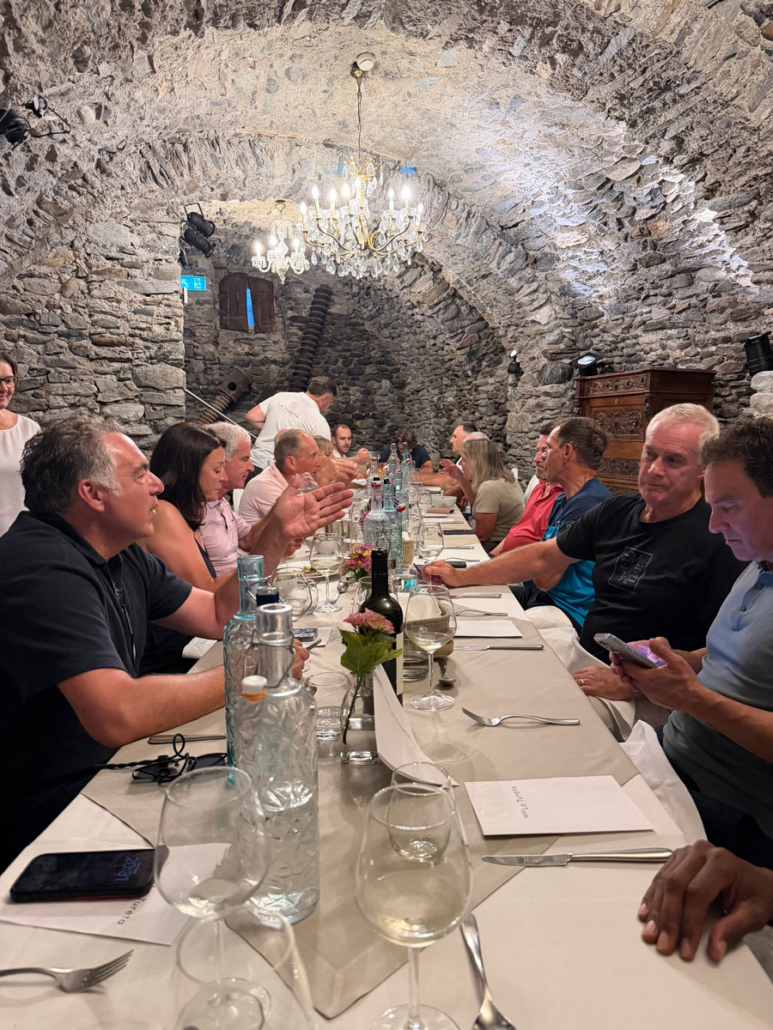
Since we were in Switzerland, the hotel was neat and organized, very efficient and everything worked. The group had a dinner in the hotel’s underground meeting/dining room that was very unique. Built in 1200, the room had a rounded ceiling, covered with rock. Whether it was a wine cellar, a place to store meat, a defensive hideaway or just a place to go in the summer to stay cool, it was something different.
And again, (I know this is boring) the food was fabulous.
The next morning, we had a little bit of a schedule because we had a reservation at a restaurant along the route of the Giro for lunch. We started from the hotel on a long, flat procession that split the group as usually long, flat sections do. That changes when the climbing starts. You can almost look at somebody and figure out their “power to weight” ratio, which is what climbing is about, as a gauge on how fast they’ll get up the hill. You’d think smaller people are the better climbers, and while generally that’s the case, it’s not always true. Fitness, aerobic ability and technique factor in as well. Some days you have it, and some you don’t. A good rhythm is important and finding the right gear usually lets you settle in for the long haul. Even though I had the e-assist on my bike, all of those things factored into me getting to the lunch spot on time.
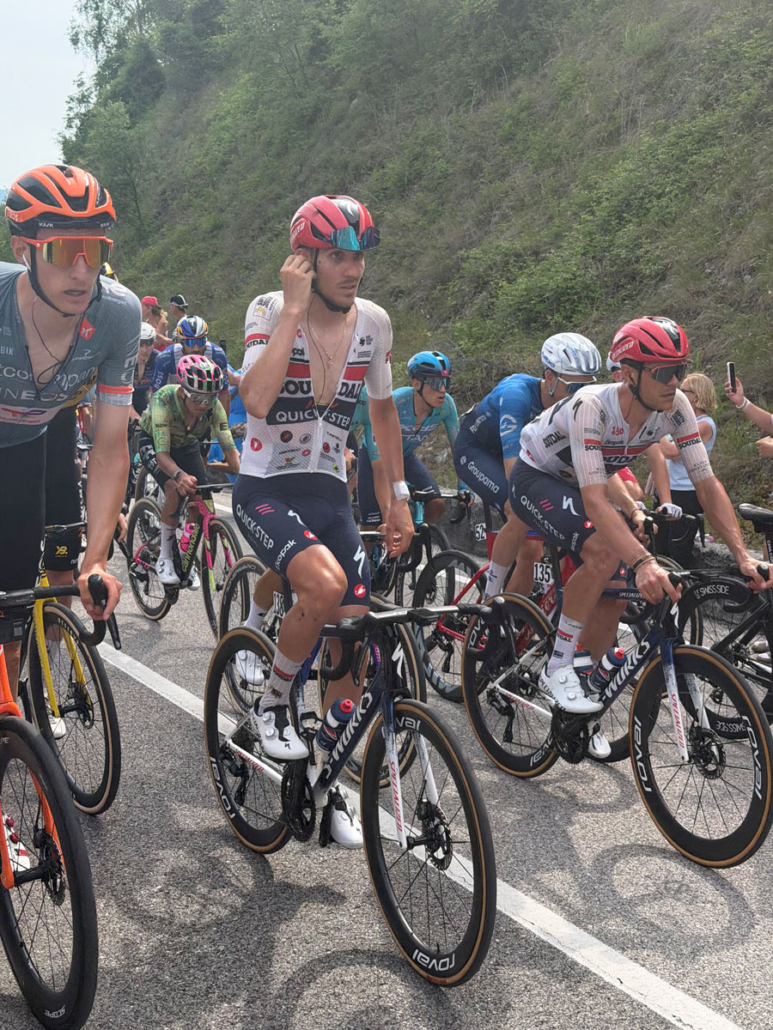
As we all gathered up the mountain, it turned out to be a great spot to watch the race. Two different times the leaders, the peloton and the grupetto (the last group of riders) came by right below the railing of the restaurant. Seeing these guys in person and recognizing their fitness and skill is amazing. I don’t know if they can dribble a basketball or throw a spiral or a strike, but man can they ride. We ate dinner that night on the patio at the hotel, excellent as usual.
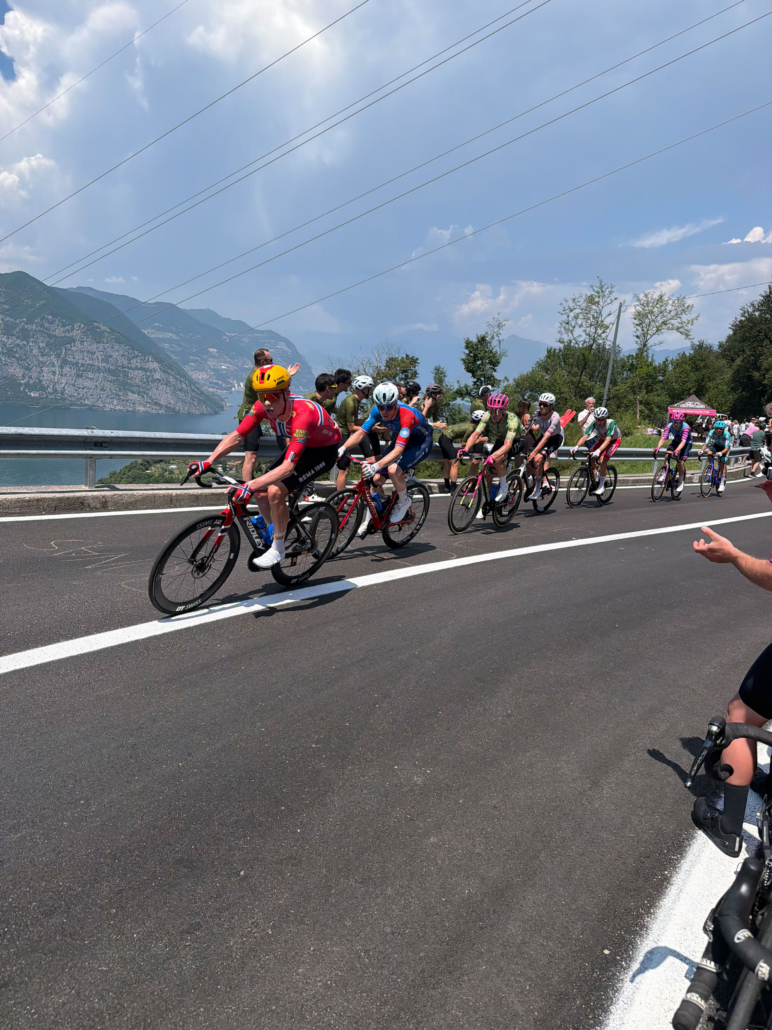
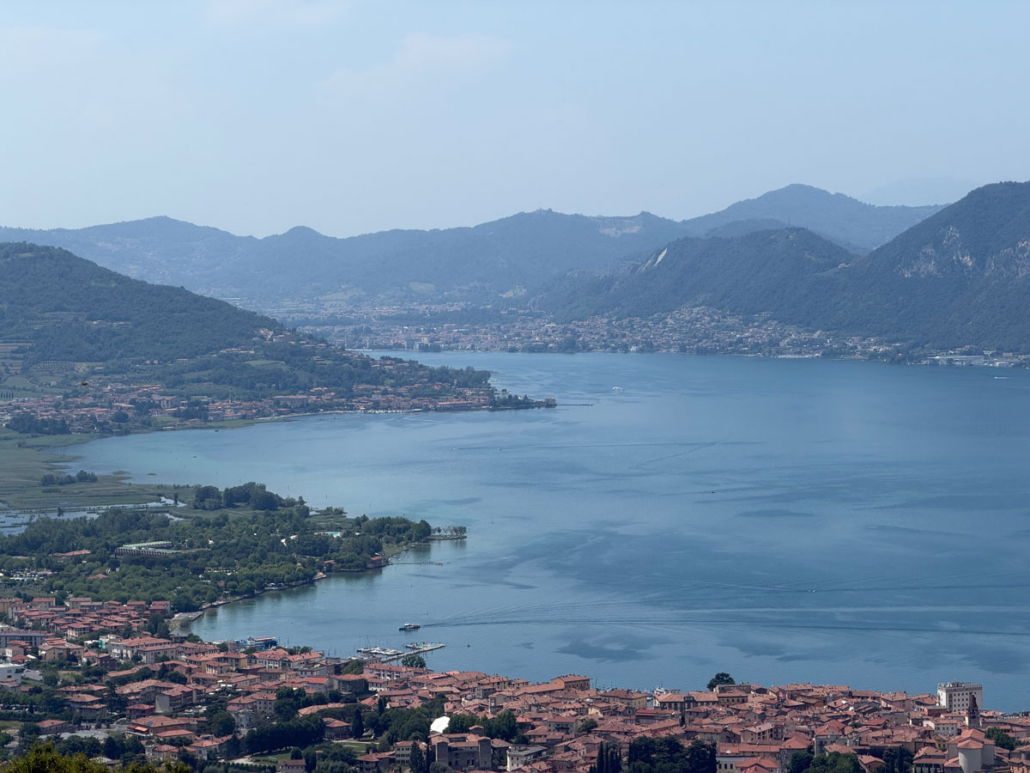
We started early the next day, checking out of the hotel, loading the luggage and heading out for the two hour drive south and east to the Veneto region where the Giro was headed. The traffic was New York/Washington/LA terrible, so it took longer to get there than expected. We saddled up immediately and headed out on a long and flat ride. I imagined this is what it must be like to actually be IN the Giro or any stage race. We were just hammering away, apparently anxious to get up the mountain in front of the race because of our delay. Lake Iseo was the star of the ride, one of those unexpected things you have no idea is coming up but is just fantastic. No coffee stop, just get on your bike and go. That flat gave way to the Passo dei Tre Termini climb, and we weren’t the only ones there. It was fun seeing spectators along the road, some even offered us water like we were real riders! We crossed a bridge into a small town that was packed six deep on either side with spectators waiting for the race.
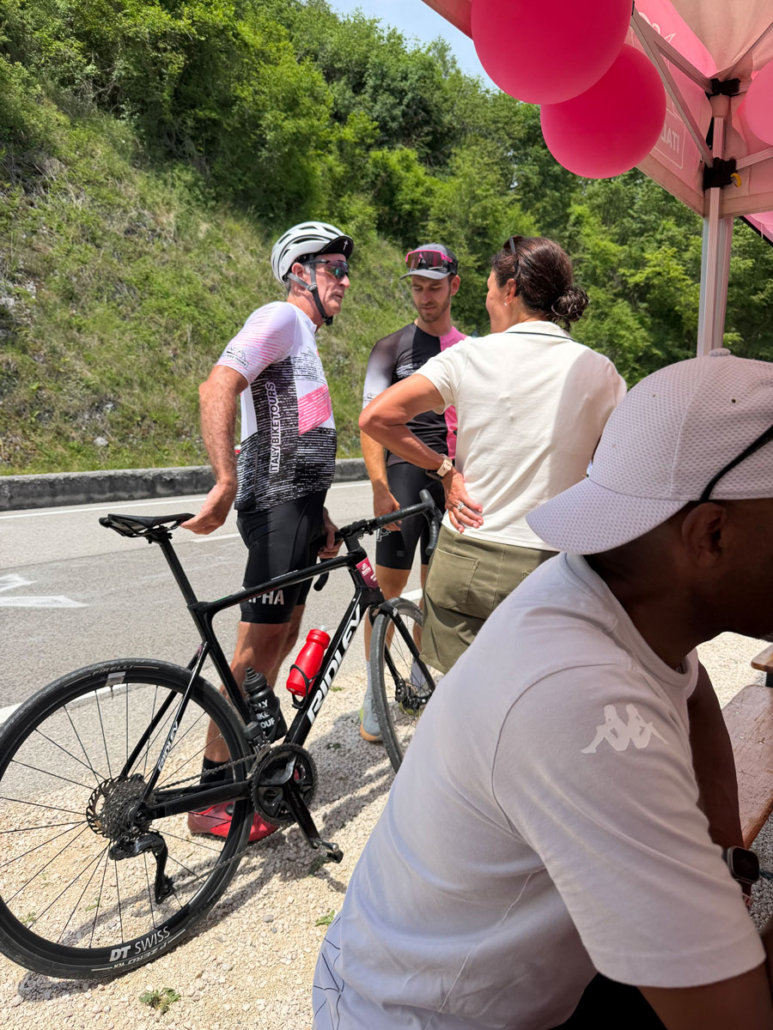
I felt a little feeling of guilt as I passed dozens of riders going up the Passo, using my gears and e-assist to glide past with ease. That feeling left quickly! What a joy to not have to struggle to get up some of the switchbacks and changing steep elevation as the route climbed the mountain. I got on Nikolai’s wheel, a young guide who was a professional rider in Belarus now living in Italy and followed him up. It was amazing to see him tactically take on the hill, and the riders on it as we cruised up the switchbacks and the changing gradient. Changing gears and positions on the bike, Nikolai delivered me to the iBT hospitality tent right on the side of the road. Realizing the top with the King of the Mountain designation was only 3 1/2K further, I got back on my bike and headed up there. I took Julio with me, and Nikolai met me at the top where a policeman stepped into the road and extended his hand, palm facing me yelling something in Italian. I stopped, and he said it again, so I said to him, in Italian, “I’m learning Italian, sorry. (In English) Does that mean turn around and go back?” Without cracking a smile, he dropped his hand and said in perfect English, “Yes, that means turn around and go back!”
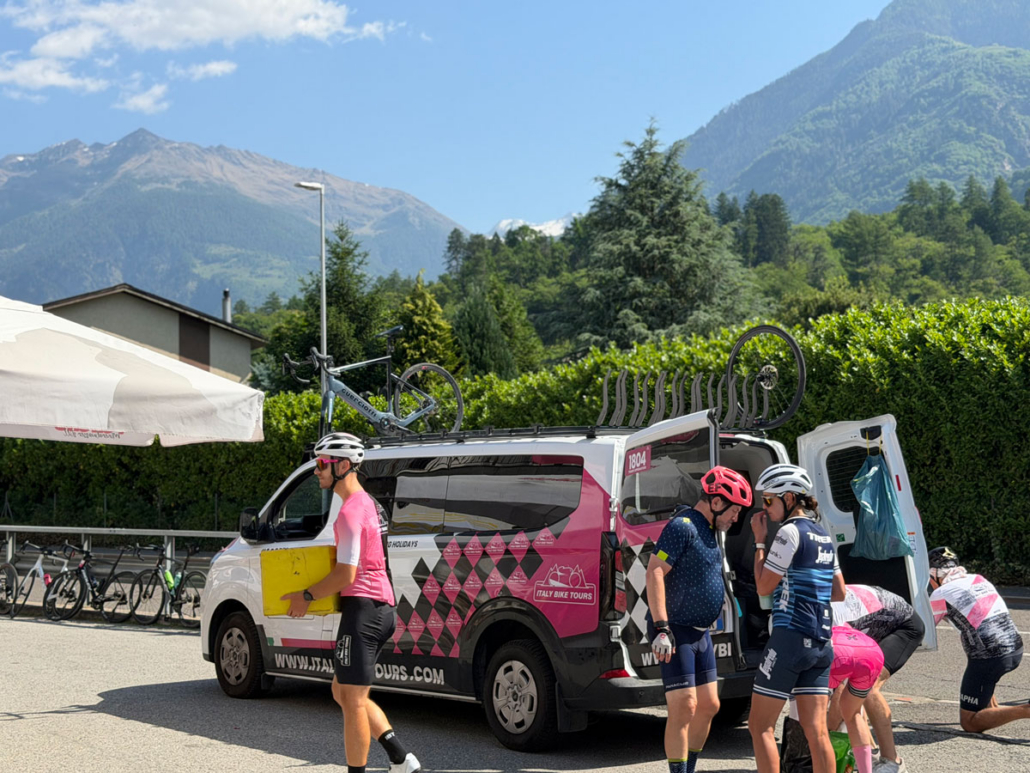
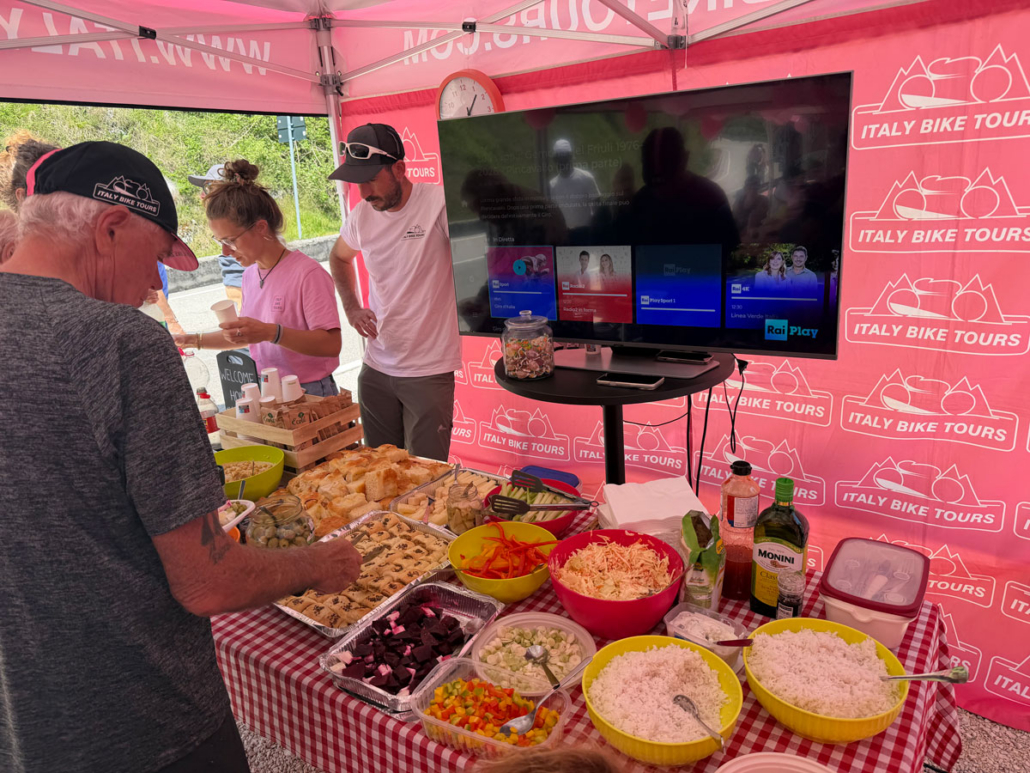
A change of clothes, snacks, liquids and a lunch awaited us back at the IBT hospitality. The stage is near their headquarters, so they call this their “host” stage. It was nice meeting people from the office, and they were as gracious as expected. Clive and Lucy own IBT, and we found out Lucy does all the cooking at home and brings it to the race! She’s a fabulous cook and a wonderful baker and it was impressive in every way.
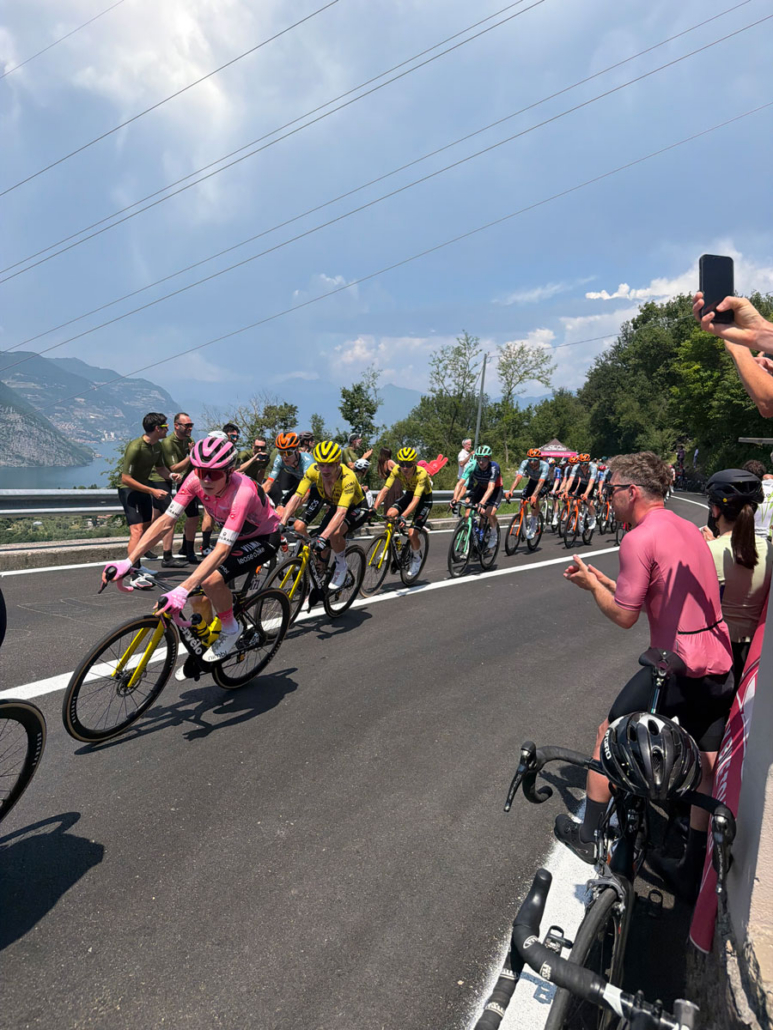
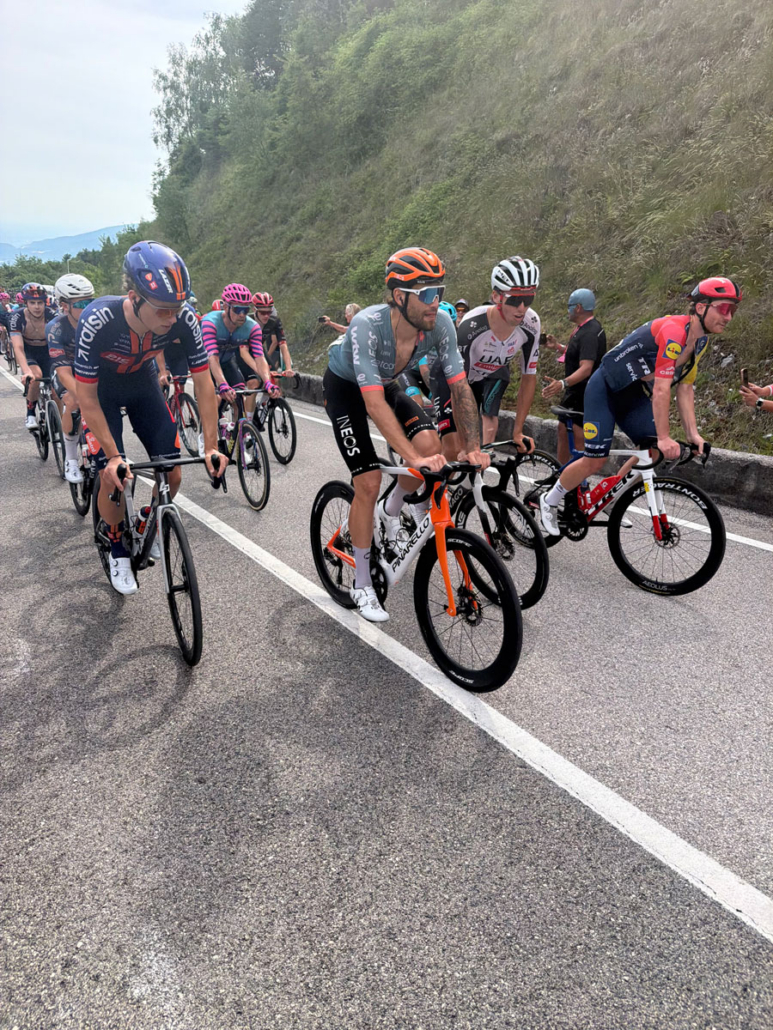
The hospitality was located on two turns in the road so watching the race go by was exciting, seeing different riders attacking, holding on, or just cruising to the top. The fans being right there on the roadside is part of the sport of professional cycling, and as close as we were, it’s a wonder guys on their bikes aren’t knocked down at every stage.
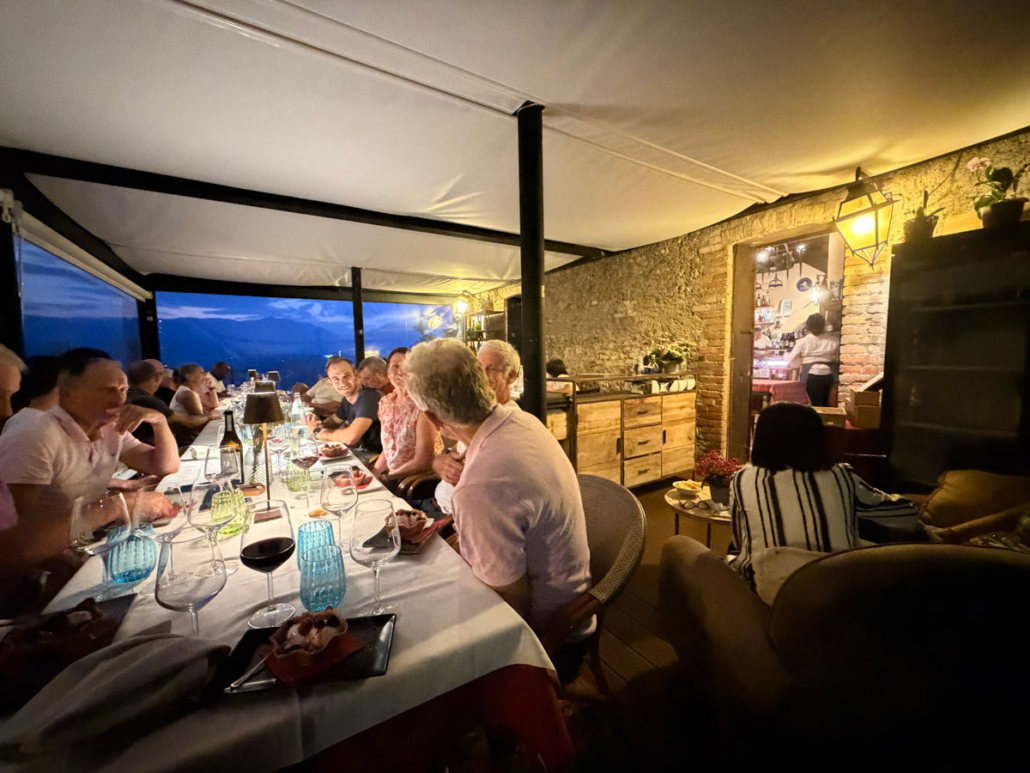
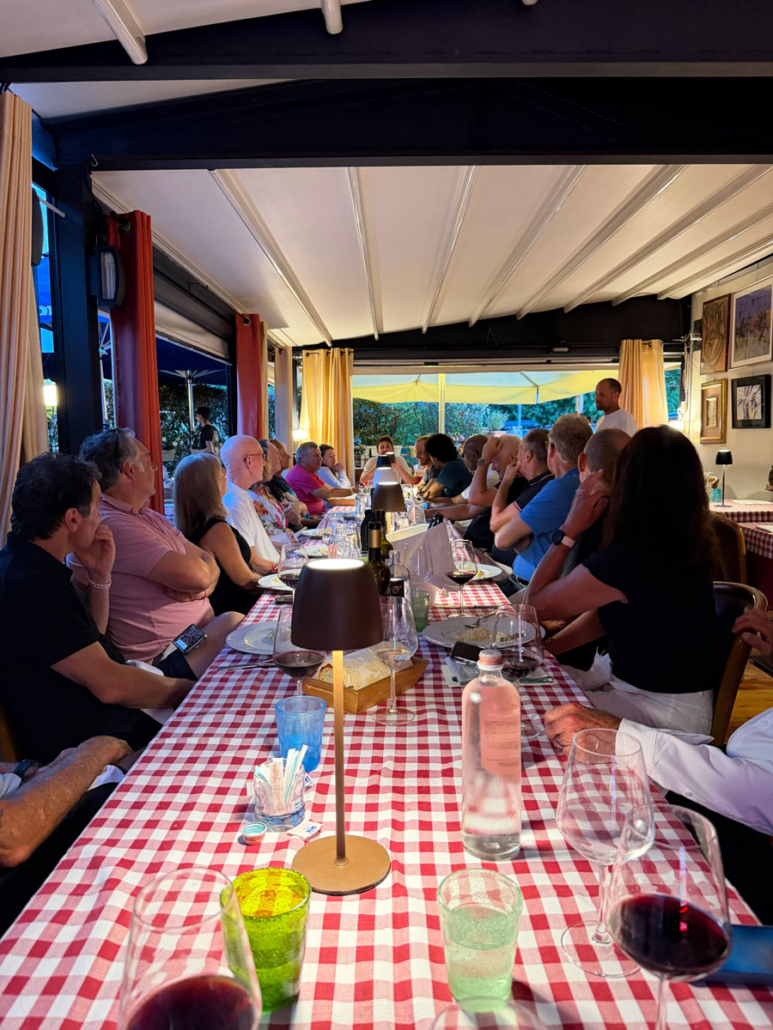
A two hour transfer to our hotel gave us a chance to shower and change for a group dinner on a hillside restaurant that looked like it could have been a monastery 500 years ago. Unbelievable view and, yes, the food was fabulous.
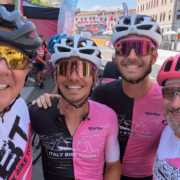
One of the fun things about going on a bike trip is the other people you’re thrown in with for the duration. IBT must market in a lot of different places, with our “12 days” group drawing from all over the world. There were eight Americans in our group. Whenever I get paired up with other riders from the US, I know we have two things in common: We like to ride, and we like to travel. And this group was no different. There’s a couple from the Pacific Northwest who live half the year in Mexico riding. We talked a lot about our mutual love of dogs! Another couple from Augusta had already been riding for over a week when we joined up. Both are very strong riders, taking on every challenge. She’s a PICU nurse and he’s an orthopedic surgeon, (I know, I could have bent his ear about my joint replacements) but since they’ve lived in Augusta for nearly thirty years, we talked a lot about Augusta National, my involvement with the tournament and they’re experiences going to the Masters over the last three decades. Really nice people.
One solo rider was from Dallas, and he was perhaps the most digitally connected athlete I’ve been around. What a great resource! If we needed to know about yesterday’s ride, today’s or tomorrow’s, he had it on his phone and outlined the peaks and valleys, the ups and downs and everything in between. A very consistent rider who had ridden everywhere, even across Italy, I ended up on his wheel a lot. If you’ve ridden at all, you know you’ve got to be confident in the rider in front of you, and I never wavered sitting behind him.
Another solo American was a track athlete in college, so he’s continued his fitness journey through cycling. He’s now ridden at all three Grand Tours and when he wanted to, he could get up and go. I ran out of hydration powder the last day and he just reached in his bag and handed me one. I really appreciated that.
I felt fortunate that most of the group was a little older and established, had ridden a bit (or a lot) and understood the dynamics of how this group of people has to coexist for nearly two weeks. There was a couple there from New Zealand. She was a non-rider, but a hoot every time we saw her at meals and around the hotel. I sat next to her at dinner one night and she gave me a full tutorial on traveling in New Zealand. I hope to use that knowledge soon. He was in the main pack all the time. Very sturdy, having completed more than thirty Ironman competitions. He proudly attached the Kiwi flag to his bike seat post, so he was easy to spot.
The group of Australians were interesting. While they hung together, they were from all over the country: Adelaide, Sydney, Melbourne, Canberra and perhaps other places. Maybe they were friends in a different time of life, or maybe they met on a bike trip, but they were fun loving, good riders and opinionated. One was a restaurateur and wine salesman; another was a recently retired sports medicine physician. We hung with them a few nights and had plenty of laughs. Apparently when the folks from “Down Under” go on holiday, they go for a while. Seven weeks, nine weeks, one rider was meeting his wife and not going back home until the end of July!
The Canadian couple were a bit on their own, with a different idea than I have when I’m on vacation. Always wanting to sit in the front of the van, and be in the front of the riding group, they rode the maximum every day, hammered the tempo when they could and wondered aloud more than once why weren’t leaving earlier. One fellow rider called them, “Intense.” Another, more kindly, said, “They’re certainly full of energy.” Not my cup of tea, but a little give and adaptability from both ends usually makes things work. At least that’s what we think as Americans. The Aussie’s had a very different reaction. Perhaps you should read their blog for details!
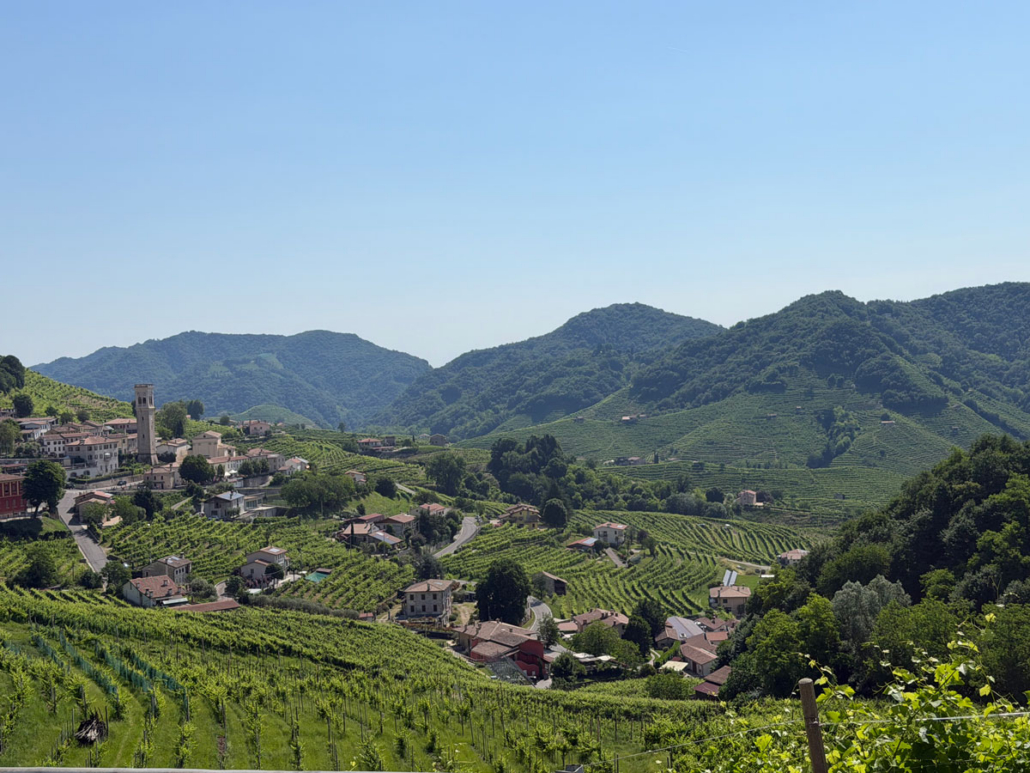
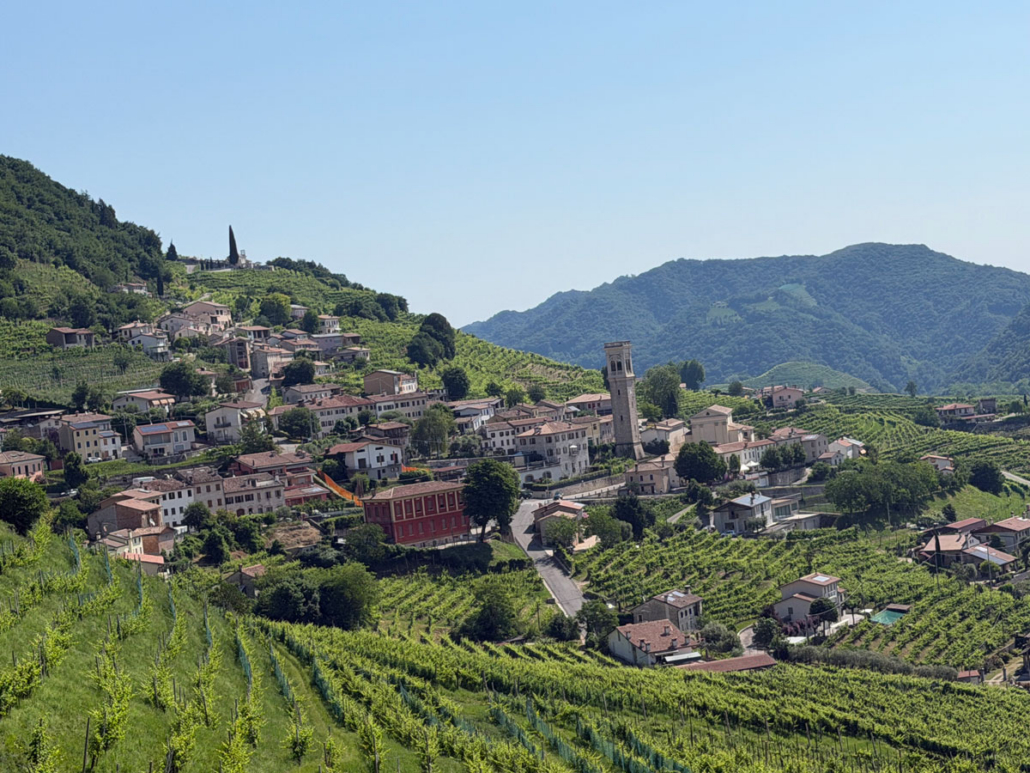
Our ride through Veneto on Thursday is one of the best rides of my life. While I woke up tired, once I was on my bike I actually felt stronger than the day before. As the cycling commentator Phil Liggett sometimes says, “He’s riding into form!” And that’s what I felt like. Understanding my bike a little better, the ride along streams and through towns, beside vineyards growing grapes for Prosecco and Pinot Grigio went by like a movie. Climbing up through lush green fields through small towns, the ensuing ridge provided one awe-inspiring view after another. Looking up onto the hillside, or down into the valley, I really had a sense of inspiration artists have drawn from living in places like this over the centuries. One rider said to me that night, “It was so beautiful, I almost cried.” I felt the same way, grateful to be there.
All of that gratitude and warm feeling came to a crashing halt as we made a hard right turn to climb the Murr Ca’ del Poggio or the Wall and the House on the Hill. It’s the sister climb to the Muur that’s part of the Tour of Flanders. On our Belgium trips we’ve done that climb several times. Hard, steep, skinny and abrupt, it gets your attention right away. I’ve done that climb in Belgium and can tell you it is similar, but in Belgium it’s steeper and skinnier, the weather is terrible and the road is cobbled and rutted. So, “similar” is correct. “Alike” would not be!
Some guy had stopped his car right at the bottom in a restricted zone and was either trying to leave or arguing with officials but either way, he was blocking part of the entrance, which meant I was concentrating on getting around him rather than prepping to go up the hill. At some points the climb is apparently 15%, so you need to be in the right gear and the right frame of mind. I thought I had the right frame of mind, leaning on my “assist” to help me up there, but without moving to the small chainring on my bike, I pretty much had no chance. When you’re climbing that steep and you’re clipped into the pedals, there’s a strategy to stopping and putting your foot down. I’m not sure I’ve ever figured it out (based on the number of falls I’ve taken) but I know when you decide to stop, your forward momentum comes to an immediate halt, and you only have a split second to get out of your pedal and get your foot on the ground. Mind you, the climb is full of people doing the same thing, as well as people who have climbed it already and are staking out a spot to watch the race. Add in those already cooking on a grill, drinking since sunup, and you get the picture.
I was fading, trying to get my chainring to change and knew I was in trouble. I spotted a small patch of grass that looked semi-flat, so I stuck my front tire in there and somehow yanked my left foot out without falling. Trying to lift my bike and spin my back wheel to get the chainring to move, I spotted Gaffu coming up the hill, confidently, and looking at me to see if I needed help. When I gave him that universal, “I don’t know!” hands-up shoulder shrug, he smoothly glided across the path and jumped off his bike. What a pro.
In a flash he had my bike on the small chainring, reminding me that “cross chaining” sometimes doesn’t allow it to move. “Get on, I’ll push you,” he said with a smile. Having already admitted I’m heavier than I’d like, I wasn’t sure he’d be able to do that. Gaffu might be 5’6 135lbs, but he seemed confident, so I made sure I was in the right gear, had some assist going, clipped in on one side and shoved one pedal around to the ground to get some momentum. I don’t know how long Gaffu pushed me, but I luckily immediately clipped in on the other side and just shot up the next portion of the hill in a flash. The bike I’m riding has five levels of assist, and just trying to save a little face, I don’t put it above three. So, with a little work, I weaved my way toward the top.
About halfway up, I went by Dirk, just standing there with a “What’s going on?” look on his face. I found out later the guy’s grilling had trundled out to the middle of the road, and he was stopped by a giant stuffed teddy bear radio station mascot. I found another flat spot and waited for him and as he went by, he said, “You good?” so I got back on my bike and followed him to the top. We both agreed it was plenty of work getting there, assist or not.
The rest of the ride was either “Italian flat” or downhill, so for the first time on this trip, I went to the front and just started pedaling. A few guys came with me, and it was pretty thrilling putting some real effort into the last 9K knowing the best riders in the world would be soon traversing this same road, only a lot faster!
We stopped about 1K from the finish line and organized another parade through the crowd that didn’t happen for about an hour. A quick picture on the podium, a change of clothes in the van (again) and we were off to the Giro hospitality named “Rafaello,” right on the run-up to the finish.
We watched the race unfold on the big screen (I sat next to racing legend Ivan Basso for a while) and when the peloton was 5K from us, we stood along the barriers to see them go by. The cacophony of sound was overwhelming standing there. Thousands of people screaming and the radio station blaring ‘80’s rock music is usually the background noise of any stage finish. Add in the announcer yelling over the loudspeakers in Italian and the church bells in the adjoining block ringing for ten minutes and it’s an experience I won’t soon forget.
Much like watching car racing, the riders go by so fast as they’re sprinting to the top, it’s hard to process quickly that they’re moving at that high rate of speed, on their bicycle! Pink smoke bombs going off celebrating the end of the stage only add to the atmosphere that’s not like anything else.
My ears needed a rest, so the van was a haven on the ride back to the hotel. It was a quick turnaround for a group dinner in town at a pizza place. And yes, the pizza was fabulous.
Another glorious day greeted us on Friday. A majority of our group left early to ride in the Pyrenees and up the famous climb Passo Giau that’s part of the Giro. It was a long van trip from the hotel, followed by a long ride, culminated by the climb, averaging 10% for as long as you could hang on or nearly the full 10k up the mountain. The finish is at the highest point the Giro this year, through nearly 7,500 feet above sea level. Having done that kind of climb before, Dirk and I opted to go see the start of the race in the town of Feltre. Our ride was ideal for the first two thirds, up and down through Veneto with lush vineyards sprawling through the valleys and up the hillsides. We climbed over several mountains, cruising down the backside more confidently than before. I’m a decent bike handler but a mechanical breakdown is something you don’t have any control over, so while my bike with me on it would fly down those descents, I try to keep the speed somewhat in check.
Our “coffee stop” was very pleasant and Dirk even commented on how good the coffee was. I’ve always read that coffee shops in Northern Italy are different than the ones in the South. Meeting there is a big part of the culture in the North, so the shops are generally beautiful, well decorated, comfortable and independent. And the people working there take great pride in what they’re doing, easily welcoming us in despite being dressed in our bike kits and cleats. Even for a quick espresso, it’s always a warm, “Buon Girorno,” from behind the counter.
Anytime I travel I try and speak some of the local language. I’ve developed a pretty good ear for languages and accents, probably from all the time I spent with my Greek grandparents as a child. But It’s pretty impossible for me in Northern Europe. I can’t pick out “yes” or “no” in Flemish despite numerous trips to Belgium to ride. I took four years of French in High School so I can get along there. In Paris they look at you with disdain when you speak their language but anywhere else in France, they welcome your effort. Italy is the same. I’ve found the most important phrase is, “Sto imperando Italiano.” Which means, “I’m learning Italian.” “Bravo,” is usually the answer. From the little bit of Greek I speak, I can similarly roll the Italian words together to sound somewhat authentic. So, “Aveti caffe?” (Do you have coffee?) or “Due doppio macchiato” (two double macchiato’s) comes easily. Many Italians are proud of their English and want to practice when you speak to them. So, it’s often a lesson for both of us when we have a conversation.
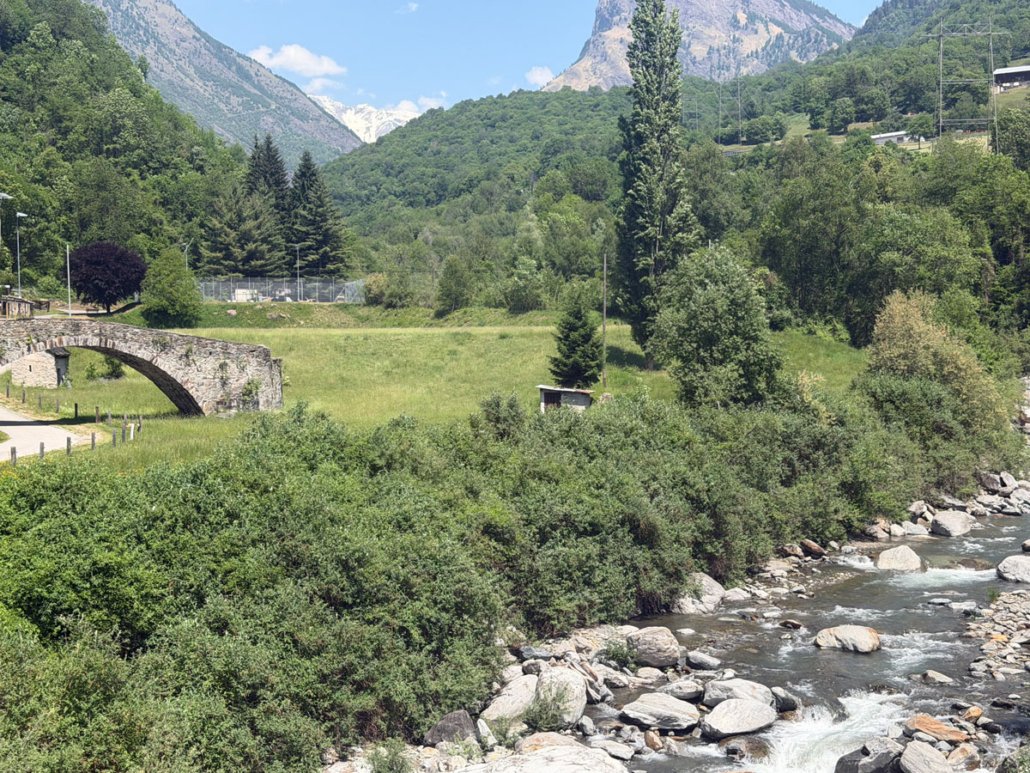
The last third of the ride was actually somewhat flat into Feltre along the valley floor and along a rushing river. The mountains on either side were steep and jagged but covered with forests and dramatic. Feltre is a small town, but it was packed for the beginning of the race. We watched the parade of riders and the start, then just tooled around town looking for a place to eat lunch. Dirk spotted a bistro on the edge of an indoor/outdoor shopping mall. We got there just as they were starting lunch, so their case was full of beautiful lunch items and pastries. A couple of sandwiches (yes, fabulous again) led to “coffee crema” and a couple of espressos followed by a stop at the nearby gelato shop.
“Ho Bisogno di un pisolino.” (I need a nap)
Saturday’s sunrise was glorious. I know because I pretty much saw it as it pierced through my window sometime right before 5:30. Having worked nights my whole career, I don’t see many sunrises, (at least on this end) and I looked out the window because I was sure some farm equipment was already plowing up the nearest field. Actually, it was just the electronic air conditioner in the corner of the room on the fritz, thumping away. I put a pillow over my head and dozed off a few times before getting going.
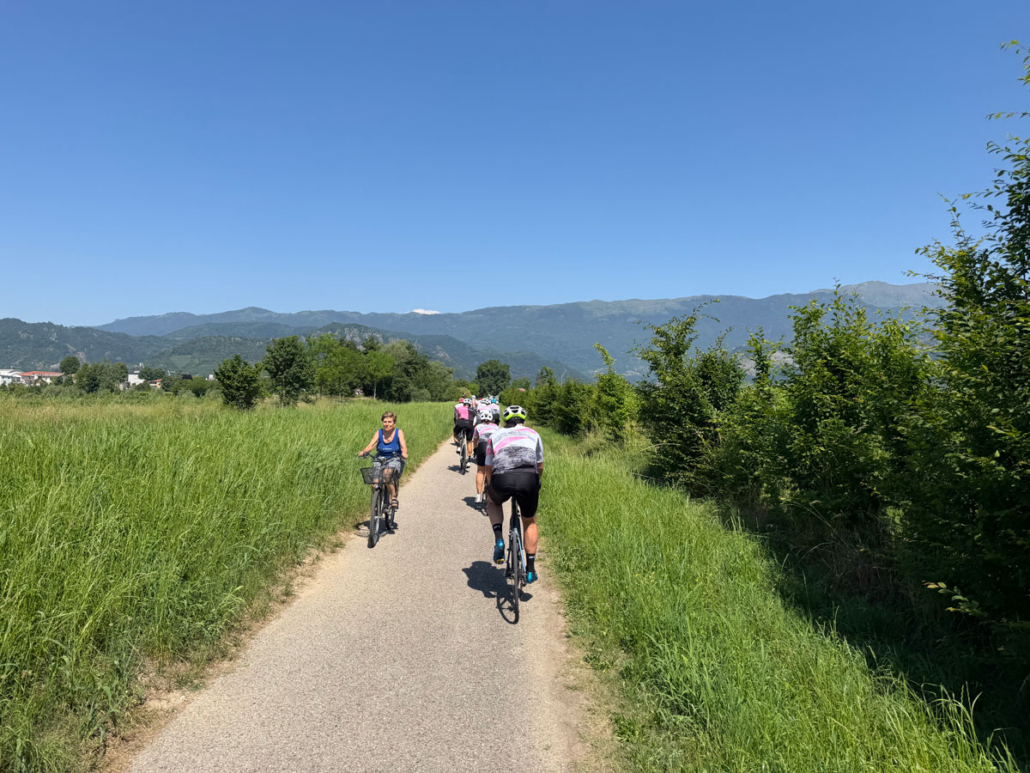
We left as a group from the hotel for our final ride of the trip through Veneto and Treviso to the slopes of Piancavello in the Dolomites. The first 40K or so was actual flat and although that 25KPH cutoff puts some drag on the 45 pound bike, since it was the last day, I kicked up my effort and stuck with the group. I’m trying to figure out a plan to ride my regular bike along the flats and somehow grab the e-assist for the climbs! Probably not going to happen but fun to fantasize about. Gaffu did a great job keeping the group together.
“The ride seems a little lighter today doesn’t it,” one of the Aussie’s quipped as we refilled our water bottles about an hour in. It was that, both physically and emotionally because our Canadian couple decided to go on their own after an apparent slight disagreement with the group the day before. Credit them for reading the room. They did join us for our final group dinner and seemed to enjoy the evening.
We rode by the beginning of the big climb of the day for a coffee stop about a kilometer away. As we went by, we saw the beginning of the climb and the chaos that was there as people were staking out their viewing spots for the two times the race would come through there. Walking, biking, and on it seemed every other form of personal mobility was being used to move up the mountain and claim a spot. A great cup of coffee and a few minutes out of the sun gave everybody a chance to regroup and start the challenge.
Having done some of the iconic climbs in Europe before, this one seemed all too familiar. It’s steep, it’s relentless and you feel like it just never gives up. In the States, switchbacks usually have a little flat spot in the middle of the turn that might give you two or three pedal strokes of respite. In Europe, they just turn right back on themselves. I had saved battery getting here specifically to use it on the climb and that worked. Despite the assist (set on three) I switched into the small chainring.
And it was still hard. I didn’t look at the percentages before the ride because I already knew it was going to be steep and hard. It seemed every part of the tarmac was covered with somebody going up, or at least trying to, at different speeds, solo and in groups. It’s tricky, and you’ve got to pick a line well in advance. Since the race hadn’t started, there were also vehicles going in both directions. You kind of get used to this chaos when you done this a few times but as Americans, when you first encounter it, your reaction is “What is going on here?!!”
Again, somebody was blocking the entrance to the climb, so I weaved my way over to the side and unclipped, looking for Dirk and some fellow riders to begin the ascent. Dirk went by and gave me the “You good?” so I waited for a slight break, (When it’s that steep it’s almost impossible, at least for me, to get started going up the hill) shot across the road, clipped in and got in behind a small group. I was in the right chainring and in the middle of the cassette, so I felt pretty good.
Just then the road turned back on itself and ticked up and everything in front of us ground to a much slower pace. I still had a handful of gears, so, leaving the assist on three, grabbed another gear, darted to the left and headed up the hill. I’m sure there was a bunch of dirty looks and cussing going on as I went by, but as I’ve said, I’ve done all that and was working to get up the hill.
Friends who don’t ride ask me all the time, “How do you sit on that seat for so long.” Admittedly, the seat or “saddle” looks uncomfortable, and you have to shop around to find one that fits you. You actually have two sit bones on either side of your glutes and getting them, and the rest of you in the right position is paramount. Finding a good pair of riding shorts with a pad you like is part of the process. Getting fitted on your bike is very important. In this situation, no matter. It’s uncomfortable and tiring and hot and you’re generally miserable looking too far up the road as it rises above you. To add to my situation, the riding bibs I wore that day I’ve had for a while, and on the way up, the pad came unstitched and bunched up in all the wrong places! Again, you have a couple of options in that situation: 1) cry 2) stop or 3) keep going! At least those were the ones I was considering and I picked number three. I have always rode on a neutral, flat saddle with a channel in the middle (www.fizik.com) so in this case I was moving all over it to find a comfortable position. Let’s just say I was actually looking for something less miserable.
I did find two guys who were going up the hill at my speed, unassisted, so I hooked on with them and put my head down. Again, the road ticked up a couple of percentages and when both of them looked back at me, I got the message that I was going to the front to set the pace. I grabbed more gear and fell into a rhythm at the front. They seemed grateful to sit in and just drone on. As the road turned back on itself and ticked up again, I went to grab more gear, and, as every cyclist has experienced, had that sinking feeling, knowing I had already reached the limit. Of course I hit it again thinking, “There has to be more gear here!” but to no avail.
So, I just doused my head with the rest of the water in my bottle and kept pedaling. Around the next bend I decided I was going to stop for a minute. Out of water and out of options on my saddle, I needed a break. But when I looked up, I saw some tents on the side of the road about three-hundred meters ahead. Was that us? I didn’t know but decided to keep going. It actually felt like a mirage as the four tents extended up the side of the road. I spotted Gaffu standing in the road encouraging me to get up there.
Looking for a flat spot to stop, I turned my wheel to the right and unclipped. In a flash, Gaffu grabbed my bike and slapped me on the back saying, “Way to go!! You made it!” I thought that was very kind, especially since the assist was almost drained. But I was glad to get my foot down and step on the bike.
Lucy came over and refilled my water bottle immediately saying, “Keep hydrating, don’t stop.” Good advice since the temp had climbed over ninety Fahrenheit. Again, Lucy had laid out a spread of snacks and baked goods, enough to feed the army of riders, spouses and staff expected on the side of the mountain that afternoon.
Shortly thereafter, Dirk and a cadre of my fellow riders arrived, all glad to stop right there. A few decided to make the trip to the top, and one of the Aussies, a very solid rider, told me later that the gradient from the IBT tents to the top was actually easier than the bottom. After a flash of regret, I remembered how glad I was to get off my bike. And my broken bibs. I changed clothes in the van.
After about an hour, the race came through and it was amazing to see the professionals literally race up the hill. At least in the front group. The climbers had their game faces on, while everybody else was just doing what they could to get up the hill. It’s pretty amazing to see one guy standing and struggling while the guy next to him, the same size, is just sitting there spinning and gliding uphill.
Once the last rider went through for the first time, Lucy and the IBT staff put out a lunch spread, again impressive, and I texted Dirk that there was food at the tents. He had walked up to the bar and restaurant and was standing in line for a sandwich and a beer when he looked at his phone and walked away. “Glad I saw that,” he told me. “I was still fifteenth in line!”
IBT broke out the prosecco and there were numerous toasts and exclamations of being finished. The staff continued to circle and hand out water and cola, keeping an eye on everybody. The race came through again, this time with the leader in the pink jersey (La Maglie Rosa) Jonas Vingegaard out in front by a minute. That was impressive. We also witnessed the Italian emergency services helicopter drop two EMT’s from a cable just up the road from us to treat somebody’s injury. They can’t get an ambulance up the road because of the race, so they brought the helicopter. We heard later they put ice on some guy’s knee!
Once the Grupetto and the “Fine Machina” (last car) came through a cascade of people further up the mountain started with a few walkers, some cars and eventually hundreds, maybe thousands of cyclists flying down the road. It looked dangerous and it was. Once we filled the vans and headed home, just a few switchbacks in we saw several people being tended to on the ground. Even in the van the descent looked steep, and I remembered we had climbed up there!
Our final group dinner was at a traditional Italian trattoria, so traditional in fact, the owner chided me for not speaking better Italian. We had a laugh about that later. Gaffu made a nice speech about the trip, and I remembered Julio telling me on one of our descents, “If all groups were like this, I’d feel like I was never working.” A nice compliment toward the whole group.
I went back to the hotel to pack, and the next morning, IBT sent a car to take me to the Venice airport for the flight home. In regular form, American Airlines was late arriving from the States, so our flight was pushed back three hours as we refiled our flight plan. Took off 2 ½ hours late from Venice so I rebooked through the American app to try and get the last flight out of Dallas home.
——–`
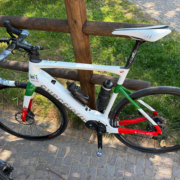
In retrospect, I can tell you this was a great trip. I’ll go with Italy Bike Tours again and hopefully I can convince some of the guys from the shop to come along and get my family to join in as well. I’m always complaining about going to Belgium when, “The riding in Italy is great, the food is fabulous and the weather is nice!” Maybe that’s why they didn’t invite me last year! The safety aspect from IBT was impressive as we rode with up to forty different riders over the twelve days without incident. Dirk’s handlebars broke during the ride thorough Como and the IBT folks were mortified. They got him another bike right away, luckily there was one in the van that was a replica of his. Even with the same pedals! IBT has a relationship with Ridley, so most of the people in our group rode the rental bike. A few brought theirs from home, and Mirco treated them as if they were his own. Although my Garmin quit working the second day we were there and Dirk’s Hammerhead was sporadic, a couple of other riders estimated we rode nearly 450 miles and climbed somewhere around 20,000 feet over the eleven days of being on our bikes.
When I asked IBT if I could leave from Venice instead of going to Rome for the final day when I was originally booking the trip, they were immediately accommodating, trimming the price accordingly. That matched the single supplement add-on, so it worked out perfectly. There are a few tweaks I’d suggest if they ask me, but they’ve been in business long enough to get almost everything right. And they’re nice people having a good time hosting us in their new home country.
Hard to beat that.