Dispatches from Augusta National: Invested in Rory, Part Two

After moving into a tie for the lead at The Masters with a third round 65, Cam Young looked to be poised to win his first Major.  After an opening 40 on the front nine of the first round, The Players champion righted himself with a stretch of forty-five holes played in -15.  A two-time winner on the PGA Tour, a Sunday Mass going, American Ryder Cup Hero, you’d think Young was going to be a crowd favorite in the final round.

He didn’t expect that.

“I don’t get the sense I’ll be the fan favorite,” he explained.  But yeah, I feel like the support, some fans that cheer for me have gotten louder over the last year. It will still be lopsided, I think. Rory’s kind of a world favorite in the golf world.”

Really?

The trunk slamming, ‘I’m divorcing my wife,’ sometimes petulant and whiny Northern Irishman, a favorite in Georgia over the latest version of Captain America?

If you frame it like that, it seems impossible, but Young was right, Rory McIlroy is the dominant fan favorite that the golf world is still invested in after winning the Masters last year and completed the sport’s “Grand Slam.”

“I grew up with Rory,” one late-twenty-something golfer and Masters patron told me Sunday after McIlroy claimed his second Green Jacket.

“He’s got crazy game, and sometimes hits it off the world, like I do,” he finished with a laugh.

While this post-millennial says he grew up with Rory, perhaps it’s as true to say Rory grew up with him. It was a bit of a shock to hear McIlroy say it was his eighteenth Masters and he thought, “I’ve got probably ten more years around this.”

Wait, what?

That’s right, Rory McIlroy isn’t that jaunty-walking, goofy teenager who just kills it and crushes the field anymore. At 36-years old, McIlroy is a seasoned, experienced, full of scar tissue, six-time Major champion with a family.

And it all happened right before our eyes.

Look back at pictures of McIlroy holding the US Open trophy at Congressional.  He was twenty-one!  At twenty-two he had collected his first PGA Championship.  Remember when his dad placed that big bet that Rory would win The Open before he was 25 — and he did it?  While that seems like a completely different person and even a lifetime ago, we’re the ones who have seen it all.

Not to say that Rory is universally loved.  He has his detractors and a segment of the sporting world that’s ambivalent, but his ups and downs, the missed putts and errant drives have all happened right there in public.  A star, not only in golf, but on the world stage, his personal life is an open book.  His engagement and last-second called off marriage to tennis player Caroline Wozniacki made headlines. His subsequent relationship with Erica Stoll was Page Six fodder.  His hasty announcement that he was divorcing Stoll and quick turn-around only fueled the gossip mongers. The PGA Tour leaned on McIlroy as their “face” during the heat of the LIV Tour split.

Add all of that together, and sprinkle in his life’s story as a child prodigy, his parents sacrifice, and him fulfilling the promise his talent portended, and you get a superstar.  But again, it happened right in front of us.

Rory’s always been available and relatable.  Golf as a sport grew on the shoulders of Tiger Woods.  But Woods has always tried to be intensely private., Although unsuccessful, Tiger wanted everything hidden. He was curt, sullen, easy to respect but also easy not to like.

Rory, on the other hand, has been right there.  Accessible and polite.  You get the feeling that if you said, “Hey Rors, how about a pint?”  He’d probably say yes and come along just to hang out.

There have been multiple comparisons to Arnold Palmer and the charisma he brought to the game. And there are similarities. Arnold was magnetic, you wanted to go with him.  Rory’s similar but in a way that you want him to come with you.  If Arnold was the movie star you just wanted to be near who might date your sister, Rory’s the guy you wanted to come along who might end up marrying your sister.

We’re invested in Rory, and that’s not going to change.  Prodigious talent that grew up next door.  We know him and we like him.

“t took me 10 years to win my fifth major,” McIlroy said Sunday night. “And then my sixth one’s come pretty soon after it. I don’t want to put a number on it, but I certainly don’t want to stop here.”

We hope not.
Dispatches from Augusta National: How Did You Watch The Masters?

There have been numerous iterations to accommodate the media covering The Masters at Augusta National.  Bobby Jones considered the media an integral part of The Masters tournament, once saying that the competition owes much of its notoriety to the writing of his confidant and chronicler O.B. Keeler.

When the Augusta Invitational first started in 1934, Jones and club Chairman Clifford Roberts scheduled the tournament in the first few weeks of April, encouraging sportswriters making the train trip back from baseball spring training in Florida to stop and report on the golf.

As a young reporter in my second or third Masters, somewhere around 1980 or ’81 I saw legendary sportswriter and author Herbert Warren Wind standing with my friend Pat Summerall under the oak tree by the clubhouse.  Pat lived in Ponte Vedra Beach, and we had gotten to know each other playing golf and through mutual friends.  Emboldened by our friendship, I walked up and said hi, and as he was wont to do, Pat politely introduced me to Wind, who’s work, legend and personality were well known.   I mean he was famous in those circles.  He had coined the phrase, “Amen Corner” writing about the Eleventh, Twelfth and Thirteenth holes, taking the phrase from a 1930’s famous jazz tune, “Shoutin’ in the Amen Corner.”

Being young and new, I didn’t know much, and as I shook his hand, I introduced myself and blurted out, “Mr. Wind, I work at Channel 2 in Charleston, and I was wondering if you might have a minute for an interview to talk about the story behind Amen Corner.”   Again, I was feeling my way through the whole reporting gig, and as a kid from the streets of Baltimore, I had a lot to learn about golf and the niceties and etiquette of the game.

Wind was a proper New Englander and wrote for The New Yorker and Sports Illustrated.  Incredulous is the only word I can think of to describe his reaction.  “Of course not!” he replied, a bit stunned by my request. Part of the “new media” of local television, I’m sure he was also confused that I would even ask him that.   Properly chastised for my impertinence, Summerall chuckled under his breath.

But it’s that kind of reverence for the game, the golf course and the competition that helped make The Masters what it is today.  There is a bit of mythology that’s entwined in the history of the Masters, created by Keeler, Wind, Dave Anderson, Ron Green, Sr., Dan Jenkins, Edwin Pope, Furman Bisher and others.

Sportswriters created the narrative, with reports going back to major media centers in the Northeast, Chicago and the far west, The Masters wasn’t just a golf tournament, it was a sporting event that defined a part of the calendar.  The official start of spring for those digging out of snow, a signal to the country to expect better weather ahead.

As the press corps grew, the club needed a place to house them on the property as they worked.  Down the hill from the clubhouse and to the right of the first fairway they built a Quonset hut in 1953, defined as “a lightweight, prefabricated structure with a distinct half-cylindrical shape, featuring curved steel ribs and a corrugated metal shell. Developed during World War II for rapid assembly by unskilled labor, it is durable, with a “clear span” (no interior support beams).”

Writers from around the country, and eventually around the world occupied the floor space facing a large scoreboard which followed the lines of the front of the curved structure. Radio and television reports occupied a makeshift second floor constructed around the outside walls.  It was loud as portable Smith-Corona typewriters banged out the day’s stores and updates.  Associated Press, United Press International and Reuters all had teletype machines in the back, hammering out the day’s news.

With a nod to new technology and the need for more space, in 1990, the club built a permanent press building on the same space and behind in the style of an amphitheater for the writers and radio and television from around the world upstairs.

With a complete reimagination of that part of the property, twenty-seven years late,r the press building was moved to make way for a larger, permanent merchandise building built by the club’s main patron entrance. A new practice facility opened, and the new (and current) press building was built at the far end. A bit of an amphitheater for workspace faces the practice area with floor to ceiling windows creating a view of every practice swing taken. It’s state of the art in every way, accommodating traditional print media, radio, television and the latest digital and social media information delivery systems.

Where did you get your Masters information?  Their web site is the best I’ve ever seen.  Live video of every shot, commentary, leaderboards and personalized options not seen anywhere else. The televised times have been increased including Prime, ESPN, Paramount+ and the traditional CBS broadcast.  Golf Channel is there all week as are numerous other sports networks from all over the world.

I did an interview with former Augusta National and Masters Tournament Chairman Billy Payne in 2019, the year he was inducted into the World Golf Hall of Fame.  The National’s Communications Director Glenn Greenspan was a nearly four decade friend and colleague and had told me that every time he presented a situation to “The Chairman” he always gave him three options: Good, Better and Best.  “Billy always chose best,” Glenn said.  “Never wavered.”  I asked Billy about that, and he was resolute in his answer.  “It needs to be the best at The Masters, always.  We have the capability to do something the best way we can, so we should.”

If you spend any time around Augusta National and The Masters as a player, a member of the media, a volunteer or a patron, you know that’s exactly what they do.

Dispatches From The Masters: Augusta National and The Masters

Every competitor who’s ever played in the Masters will tell you; no matter how much you practice, no matter how early you get to Augusta National, the golf course is completely different when you tee it up in the first tournament round on Thursday. Part of it is how the golf course it set up for competition.  The greens are a bit faster; the fairways are cut a bit shorter and the wind always seems to change.  The other part is now it counts.  Playing Augusta National is one thing, playing in the Masters is completely different.

Nobody is making a nine on the fifteenth hole in a practice round.  But that number popped up on a few scorecards in Thursday’s round.  A putt off the green would elicit generous laughter from your fellow competitors Monday through Wednesday.  A sympathetic “Ooooh,” from the patrons attending the first round is what you’d hear.

Those patrons know it’s possible, and they have genuine empathy for players difficulties all over the course.  As much as the roars from Amen Corner are a part of being at The Masters, knowledgeable golf observers and their reactions to successes and failures are also part of the soundtrack of the tournament.

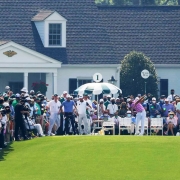
While the golf course changes from practice rounds to tournament rounds, the patrons change as well.  On Thursday, those in attendance are a little older (thus, I fit in) but not too old.  In fact, this year it seemed there was an influx of the next generation of Masters Patrons.  Those on the golf course are quieter, more respectful, more knowledgeable, a little better dressed, and not weighed down with bags of merchandise.  While the club and the course are still the stars, the patrons in attendance are there for the golf.

There are many different ways to watch play at Augusta National.  There are no hospitality tents on the golf course. The focus is on the golf.  There are concession stands, tucked away in the Georgia pines, easily accessible but not visible. You can grab a beer and a sandwich, at legendary low prices, and walk right up to the ropes to see the best players in the world right at arm’s length.  There are some tournaments that bring the fans close to the action, but at the Masters every time you look around, some player is right in front of you trying to execute a shot that would seem impossible for mere mortals.  Sitting on a hillside in front of the 6th tee, the players tee off over your head.  To the side of sixteen, there are chairs that overlook action on the par three and the scoring shots on fifteen.

There’s a tradition at the Masters where patrons bring their official green tournament chair early in the day and even early in the week, place it in a nice viewing spot and leave it.  Nobody bothers it, nobody moves it, the chair just stays there.  You can come and go, other people can sit there while you’re not there, but it’s part of the landscape of the week.

We’ve seen golf courses built with “spectator mounds” and “viewing areas” but while Augusta National was built with hosting a tournament in mind, the natural elevations and mounds that were part of the design of the course provide viewing spots on every tee, fairway and green complex.

Playing golf, or watching golf at Augusta National, like Jim Nantz says, is a tradition like no other.


Dispatches From Augusta National: The “Feel” of The Masters

It always drives me crazy and now it kind of makes me laugh when some reporter asks, “How does it feel? “Every athlete says, “It feels amazing! Unbelievable!” Or if I’m in a press conference and somebody says, “Tell us about such and such?” That’s not a question. That’s either uninformed or lazy.

At Augusta though, it is a little different. Bobby Jones once said, “Competitive golf is played mainly on a five and a half inch course … the space between your ears” So, how it feels is important. If you play golf, you know that depending on the situation, what pressure you might be under, what’s on the line, all count as part of executing the next shot. You never know how you’re going to feel when the shot presents itself. That’s part of the game at the highest level as well. Getting into contention, having a shot that really counts all goes into how you’re going to react. The best players know, and learn how to be, “Comfortable being uncomfortable.” It’s one of the reasons they say that the Masters at Augusta National doesn’t start until the leaders reach the 10th tee on Sunday.

With the history and tradition and the legends of the game enshrined as winners, there is a different feel to The Masters, and it starts, at least for the professionals, when they drive down Magnolia Lane.

“I think growing up as an American golfer, I think Augusta is the place you always want to get to,” two time Masters Champion Scottie Sheffler said on Tuesday. “Whether or not it’s to play in the tournament or just to get to see the golf course. For me, I truly feel that once you drive down Magnolia Lane, everything else melts away, and you get to be here and be focused.”

To give the players a chance to be focused, Augusta National has smoothed out every process the players seem to endure at other tournaments. They’ve built underground parking under the member’s practice area.

That’s connected to the new Players Services building that houses the locker room, a gym, a physio space for stretching and massage and every other thing you can think of a player would need to get ready to play. Even the teeing ground at the practice facility is heated in case there’s a frost delay. Players will still be able to warm up and be ready to go when the weather allows.

Some players have said they don’t want to attend the Masters until they’re playing in the tournament. Not Tommy Fleetwood. He says he “managed to get a ticket” in 2014 and he just came to watch, thinking it would be motivation.

“I would get to see it before I came,” he explained. “It was more I remember walking around, and you get to the back of the 12th tee, and that’s as far as you can go as a patron, can’t go any further. And I’m watching these players go play and walk over the bridge to 13 and then teeing off on 13, and I was like, I want to go there. That’s where I want to be.”

And when Fleetwood played his way into the tournament, that’s what he was thinking about. “I think that became my thing about playing in the Masters. When I play, I get to go and get to the 12th green and the 13th tee. So that was like my — sort of my biggest motivation in a way. I never even contemplated at the time winning it.”

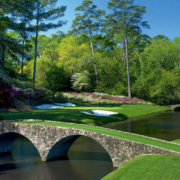
That spot around Amen Corner is unique in tournament golf. The patrons at the tournament can see every shot back there, but the players are away from everything but the golf itself.

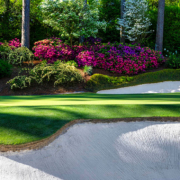
“It’s serene, it’s peaceful. It’s an opportunity to gather yourself amidst the buzz of the tournament.” Bryson DeChambeau opined when asked about how removed that part of the golf course becomes. “I think it allows us to take a mini break. It kind of settles you in for the rest of the round. It’s a nice space. It’s a really fun space to go back to and be around all the azaleas, and I think there’s a couple dogwoods back there. It’s fun. I’m a nature guy. I like knowing what’s back there.”

It’s no surprise that the rarest of winners are those who have donned the Green Jacket in their first attempt at Augusta National. Horton Smith, who won the first one in 1934, Gene Sarazen in his first the following year, and Fuzzy Zoeller in 1979 are the only players to accomplish that feat.

Knowing the golf course counts.

“I think the experience is the biggest thing here,” said former U.S. Open Champion Matt Fitzpatrick. “I think the more you can learn about the golf course, the better. There’s obviously so many different things that you need to learn, I feel like, for the golf course and the more experience you have, the better chance you have of succeeding here.”

Defending Champion Rory McIlroy agreed. “You come back — the other major venues, we don’t go back to the same place every year. So, I think that is something I feel like I’m still young, but I’m very experienced. I’ve been doing this for a long time. This is my 18th start.
I just think that everything here is a little more predictable. You know the golf course pretty much. There’s subtle changes year after year, but the hole locations are always in similar spots. I just think the more experience you have around this golf course, the better it is.”

Winning it has changed how McIlroy approaches the week. He noted that would have never gotten to Augusta National so early, preferring to wait until sometime Monday evening or Tuesday to be on the grounds.

“I think for the past 17 years I just could not wait for the tournament to start, and this year I wouldn’t care if the tournament never started,” McIlroy said in his press conference Tuesday to much laughter among the press corps.

Wearing his Green Jacket, Rory related that it’s all a new experience for him. “Yeah, it’s completely different. I feel so much more relaxed. I know that I’m going to be coming back here for a lot of years, going to enjoy the perks that the champions get here. It doesn’t make me any less motivated to go out there and play well and try to win the tournament,”

Dispatches From The Masters

I’ve made this drive a hundred times.  Maybe two hundred.  From my first trip in 1979 from Charleston to this year from Ponte Vedra Beach, it never gets old.  Driving to Atlanta is all about interstates and traffic.  Driving to Augusta is about savoring the countryside, the anticipation of what the week might bring,  and how the golf course has changed and how it looks.  Azaleas in bloom?  Green as ever?  With the tournament being scheduled the first full week of April when that Monday isn’t the 1st, just a few days and perhaps a cold snap or thunderstorm can alter the appearance of Augusta National.

From Charleston, the drive is a combination of backroads and working towns, farms and warehouses.  You could take I-26 up towards Columbia and cut over on 301 and 4 to I-20 and come in that way from the north. But you’d miss stopping for gas in Ridgeland and having the clerk ask, “How are you today?  Headed to the toonament?”

According to Google Maps, the Interstate route is 2 Hours and 46 minutes.  I always preferred going through Summerville on 78 and heading northwest through Ridgeville, St. George, Reevesville, Branchville, and the aptly named town of Midway before crossing over 301.  From there you hooked up with 278, which took you right to Augusta.  I learned a lot about farming on those drives.

Two or three times during my tenure in Charleston, the General Manager of the TV station I was working at would rent a plane and fly us up there and come back the same day, home in time to be on the six o’clock news. You could still just walk up and buy a ticket to the practice rounds.  I’m not sure if he just wanted to go to the Masters or go flying, or both.  I understand either motivation.

I was very happy in January of1982 when my credential followed me to the station in Jacksonville, my next professional stop.  I was told when I took the job that the station had lost its credential in the past and I figured my covering the Masters was over.  But the letter on my desk from Martha Wallace inviting me to apply for a credential in late January was a welcome sight.

But I didn’t attend the Masters that year.

My wife, Linda, was due with our first child that week and I didn’t want to chance being nearly three hours away (before cell phones, which wouldn’t have been allowed on the grounds anyway) and not being able to get back in time.  So, I let Martha know I wouldn’t be coming that year, and why, and she graciously said, “Well good luck, and we’ll see you next year!”  True to form, our daughter Austin was born on her due date, April 10, 1982.  (That night the New York Cosmos of the NASL were making their only appearance against the Tea Men in Jacksonville and I missed that too.  It rained like crazy.  The Cosmos won 2-0).  Craig Stadler won the Green Jacket that year, and now that he’s a neighbor of mine in Florida, I’ll have to mention that to him the next time I see him.

The drive from Jacksonville was different but no less enlightening.  Also just over four hours, I used to take I-95 to just north of Savanah and go up 21 through Rincon, Springfield, Newington, Hiltonia, Sylvania and Sardis (home of Cale Yarborough) and straight into Augusta.  I altered that sometime in the early ‘90’s when they finally finished the construction on 25 going to and through Statesboro.  It’s still just over four hours, but up 95 and west on 16 before jumping off on 25 and heading north is now the regular route.  It takes you through Millen and Waynesboro, right through the intersection where Sam Snead had an accident driving to the tournament in 1992 from his home in Ft. Pierce.  Snead, a three time champion and 78 years old that year, missed being the honorary starter because of the accident and was cited for running a stop sign and driving too fast.  The driver he hit was left paralyzed.

Once, I took a commercial flight into Augusta.  I don’t know where I was coming from, maybe covering the NCAA basketball tournament somewhere, but it seemed kind of silly laying over in Atlanta for the short hop to Augusta Regional.

Since becoming a pilot more than two decades ago, I’ve flown into Augusta Regional plenty during the tournament but most recently they’ve moved small planes over to Daniel Field, not far from “The National.”  On Wednesday night of the Masters, it’s always been said that Augusta Regional hosts the largest collection of private aircraft in the world in that calendar year.   Hard to say, but they do close one runway to make room for the jets that fly in from all over.  N1AP (Arnold Palmer’s Citation X) was always parked in spot one, with N1JN (Jack Nicklaus’ G5) right next to him.

This drive happens to be at lunchtime on Monday, with my brother and my nephew. although I’ve made the trip Sunday before the tournament and almost every day after that.  Anytime we can get tickets, my brother and I make it a point to meet at The Masters.

The 2020 trip was unique, because the competition was delayed until November that year due to the Covid-19 outbreak.  I never knew how many cotton fields there were in that part of Georgia until I drove it in November. The growing season.  If you didn’t know better, you’d swear it snowed on that plot of land!  The red clay and the white cotton balls make quite a contrast.  Arriving at The National, I was directed to the large Patron Parking lot down Berkman’s Road to the Covid testing tent.

Pulling my car into tent, as I went to get out, I was greeted with a sign instructing me to stay in my car. Two nurses in Hazmat suits came out of a temporary building with a piece of paper and held it up to my window with instructions.  “Roll your window down a few inches to begin the test,” I read.  They slid another piece of paper into the car, with instructions on how to take the test.  Two long q-tips and a holding tube followed.  I took the test and handed it back to them saying, “I’ll just park over here to use the bathroom.” “Pull over there and stay in your car,” were the firm instructions.  Having driven four and a half hours, perhaps a bathroom stop earlier would have been in order.  As I pulled to the right, although I had no indication that I might have Covid, it occurred to me that they might just send me home if the test came back positive.

I was given the green light to attend the tournament, but others weren’t so lucky.  Former Players Champion, Jacksonville native and Former #1 in the world David Duval had made the more than twenty hour drive from Denver to continue to serve as one of the lead analysts on The Golf Channel coverage.  A negative test sent him back to Denver for the week.

Monday is usually a day to get organized, although there are a few press conference opportunities in the afternoon.  I’m looking forward to what Justin Rose has to say  Easy guy to like and he’s been close here, in playoffs, a couple of times.